.gif)
PODCAST
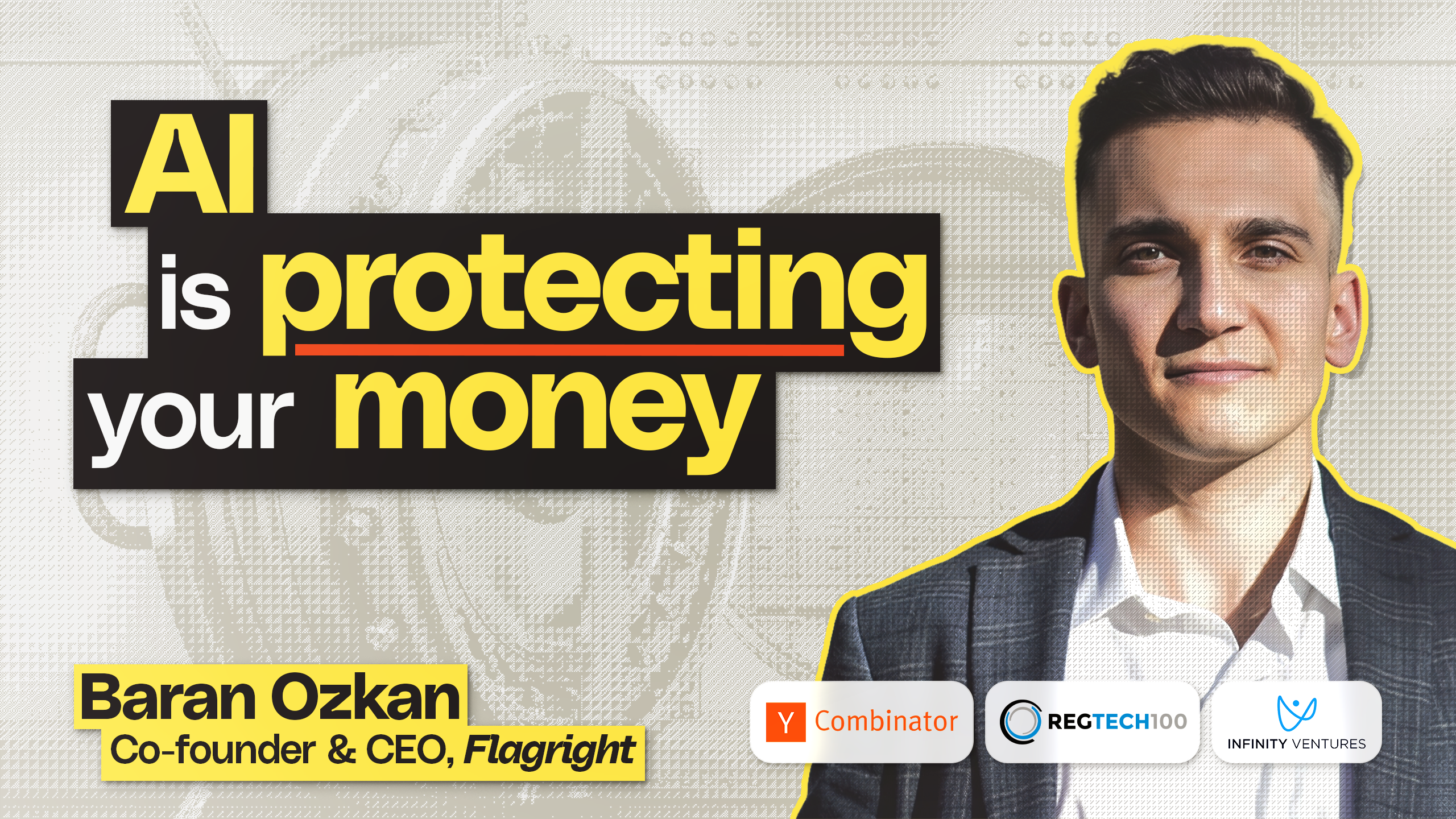
How Flagright uses AI to keep your money safe | Baran Ozkan, Flagright


{{big-quote}}
The tools banks rely on to catch fraud were designed for a world without deepfakes or AI voice cloning, but those threats are growing faster than legacy systems can adapt.
Baran Ozkan, co-founder and CEO of Flagright, has teamed up with a long-trusted friend to build an AI-native system that helps companies stay ahead of financial crime. Backed by Y Combinator and now running in 35 countries across 6 continents, Flagright protects everyday money from the scams and social engineering that older systems were not built to catch.
💡 What You'll Learn:
Jonathan Nguyen (0:00)
With just three seconds of this video, anyone can clone my voice and ask my family for money. And the software most banks use to stop that, built before any of this existed. Voice cloning, deep fakes before AI could be weaponised against anyone with a bank account.
Baran Ozkan (0:16)
We are here to protect that money and make sure no one gets between your money and what you want to do with it.
Jonathan Nguyen (0:21)
Baran Ozkan is the co founder of Flagright, an AI native financial crime OS backed by Y Combinator now operating in 35 countries. I asked him why the biggest threat isn't the scammer. It's the legacy software that was never built to stop them.
Baran Ozkan (0:36)
They were created in an era where this wasn't possible. So they couldn't actually imagine an architect for this future.
Jonathan Nguyen (0:53)
Welcome back to another episode of the Unsensible Podcast, where we talk to the unhinged founders who are going after the money launderers and gangsters who are after your hard earned cash. On the podcast today, we've got Baran Ozkan from Flagright. He runs exactly that kind of a startup. Baran, how are you today?
Baran Ozkan (1:16)
Great, Jonathan. Thanks for having me. How are you?
Jonathan Nguyen (1:19)
Very good. I see you've got a very nice background there. Is that Singapore CBD that you're in at the moment?
Baran Ozkan (1:24)
Yes. That is Singapore CBD.
Jonathan Nguyen (1:27)
Awesome. We have one rule and the first time you're on the pod you've got a pitch.
Baran Ozkan (1:31)
Happy to. So Flagright is an AI native operating system for financial crime compliance. We serve BFSI sector, so banks, financial institutions, fintechs, insurance, brokerages, crypto companies, and we help them comply with AML compliance regulations and obviously prevent financial crime.
Jonathan Nguyen (1:49)
Amazing. You're from Turkey and you trained as an engineer and you did your master's in Florida. And now you're in Singapore. How does this arc happen?
Baran Ozkan (1:58)
Yeah, so once I got my master's degree, I started working in The US and I moved on to Germany. I lived three years in Berlin, again in product management across multiple sectors. Then I moved to Lithuania. Most people don't know this, but it's the FinTech capital of European Union. There are just a lot of FinTechs there.
Politically, they also invest a lot in the financial sector. They see it as a competitive advantage as a country. I had a great mentor who taught me a lot about AML compliance and financial crime prevention. I had a negative experience there trying to buy a solution for transaction monitoring at the time, and I ran an RFP process for two years. Long story short, I was extremely frustrated with that experience and I saw a gap in the market where a lot of the fast growing companies were getting their hands tied.
It's a critical and mandatory function for you to have to maintain your business and your business licence, regulatory compliance, etc. From there, I teamed up with a good friend of mine, with whom we worked in the same startup in Germany before. One thing led to another, we found ourselves in Y Combinator. And from there, things picked up quite quickly. So in four years, we now expanded to 35 countries.
Then we saw quite a strong pull from the APAC region. For that reason, I moved to Singapore to run our APAC expansion.
Jonathan Nguyen (3:09)
That's amazing. Like that's quite a lot of countries. Did you just have a suitcase that you were travelling around with, or did you have to move a whole house?
Baran Ozkan (3:16)
I moved out of my hometown and away from my parents when I was 17 for college. Since then I've been abroad, so it's now my thirteenth, fourteenth year abroad. The sad thing about that is you lose sense of home at some point. You don't know where you belong anymore. Now even if I go back to my home country, I kind of don't belong.
I lost a lot of the things that people do, and for me it feels odd because I'm now used to something else. There's a certain level of assimilation that you are exposed as an immigrant. From that perspective, it became easier and easier after every move. So I was four or five years in The US, three years in Germany, three years in Lithuania, now past two and a half years in Singapore.
Jonathan Nguyen (3:54)
Yeah, I kind of understand what you mean by that sense of home, because I've been out of Australia, moved from Australia to Hong Kong, Hong Kong to Vietnam. And most of the time I was living out of a suitcase anyway. I always think of places in terms of where am I now? Less so of like what's home? Because that exactly to your point, that sense of like, I have friends who I went school with who haven't left the neighbourhood that we grew up in and they have a very strong sense of home and their community.
Whereas mine is very different in that I have a good friend in this country and I have some family here and some family there. Do you think that that is any way related to your, I would say, risk appetite and likelihood to become an entrepreneur? Do you think there's any correlation?
Baran Ozkan (4:41)
I think maybe being an immigrant leads you to be an entrepreneur, because not having any support functions that otherwise you don't appreciate until you don't have it. And you don't have the resources, people helping you out, family, colleagues who help you get an internship. There is no mama cooking for you back home. I think it just makes you a lot more resourceful and formidable as an individual. From there you start seeing opportunities and how to fix the problems.
Just it gets you to think from a first principle's perspective and maybe have a more positive outlook on life. And I think over time you get to branch out solution mindset onto other problems that you see around you, and maybe which eventually, you know, makes you an entrepreneur.
Jonathan Nguyen (5:22)
Interesting take. So you arrived in Florida, you started working for a company I think called Florida Blue. And was this where you were trying to find an anti money laundering solution and failed?
Baran Ozkan (5:35)
No, there I didn't know much about AML compliance at the time. I was working in IT side, but you know, in the sales department. We were building software solutions for insurance industry specifically. It wasn't until Lithuania, where I was very deep into AML compliance, where I was actually building hands on financial crime detection tooling.
Jonathan Nguyen (5:54)
And so you were building that in house?
Baran Ozkan (5:56)
Yes, in house. And I was also responsible for making the recommendations to buy tooling, be that ID verification, sanction screening, fraud detection, transaction monitoring, case management, so the full stack. And there are so many different tenets you have to consider when it comes to financial crime domain.
Jonathan Nguyen (6:13)
I would say it can be quite a technical area. I'd love to hear if you could put it into a custodial term. How does what you guys do affect the day to day general public?
Baran Ozkan (6:25)
Our system can protect an elderly losing their monthly retirement salary out of a scam. Under the hood, that would be our system. On the surface, it would be a financial institution. Think about the large banks like UOB DBS, all the way down to smaller fintechs. Everyone uses money to trade, purchase goods, send to their loved ones, and there are also a lot of scammers, so we are here to protect that money and make sure no one gets between your money and what you want to do with it.
Jonathan Nguyen (6:52)
So at the heart of it, it's understanding what's a real transaction. What's the transaction where Jonathan's gone up to an ATM, entered his PIN number, pulled out some money, versus Jonathan pulled some money out of the ATM in Singapore, but then also suddenly tapped his card to buy something on the other side of the world. Is that the kind of thing you're talking about?
Baran Ozkan (7:14)
Yeah. That is one example. Social engineering is a lot more common than someone actually stealing your card information. For example, abusing the elderly, impersonating using these new AI solutions, and you believe them, you, as an elderly, at midnight, withdraw 2,000. Now that could be a suspicious activity from our perspective.
For certain use cases, you might wanna protect that. By the way, this is not always gonna manifest itself in a customer friendly way. Because what if you actually want to withdraw that money? And if the bank is freezing those funds, then you will be frustrated. There are two sides of the coin of customer experience and protection.
The institutions always try to on the safety side sometimes, because they are also gonna get hand slapped by the regulators if something goes wrong. So, you know, it's not very easy to manage.
Jonathan Nguyen (7:57)
You raise two interesting points there, which I wanna drill into a little bit. The first thing is it's very easy to block something that falls out of parameters. The hard part is understanding the nuance of, 'Well, this is a strange transaction.' Drill into that a little bit. Explain what kind of trade offs.
What are some examples you have to kind of balance?
Baran Ozkan (8:19)
There are two things here. First one is, can you actually introduce the friction, but make it sufferable? For example, they might just send you an SMS telling you to click something to confirm it was you and unblock it immediately. It might be an inconvenience, but you can fix it on the spot. And the second part is, you can block something to a certain extent to protect the customer.
Then what's the definition of protection? Which might be, just an example, a function of your income. If you are making 100,000 SGD per year, you would be upset for losing 1,000, but you wouldn't be on the street. Versus if you are making 30,000, that might be a lot of money. Then will you be on the street because you won't be able to make rent?
You're gonna cancel the contract, etc. So I think it's always based on the use case, who are we talking about, what type of use case is it, what type of scenario, payment method, jurisdiction, what's at stake, I think is what I'm getting to. So it's not as simple as how do we block or not block it, but how can we actually manage the complexity with very configurable, flexible financial crime compliance systems that both protect our business as a financial institution, but also deliver great customer service. We always think about how do we actually help you make more money as a business while being compliant. Not just being compliant, because business won't exist.
So how do we sustain the business and help you grow, deliver great customer experience while making sure regulators are happy, audits are cleared. You are not being an instrument to any type of suspicious activity. You are happy and sleeping well at night. So how do we combine the best of both worlds here?
Jonathan Nguyen (9:47)
That's an interesting point you raise. Today there's probably a much higher prevalence, bit of a grey area in that you also have to play a role in stopping the account holder from transferring their money sometimes. Have you observed a trend over time that, you know, a shift? Have you seen it?
Baran Ozkan (10:06)
This also has different flavours in different countries. Also depends on what they call it in different industries, so friendly fraud, account takeover, romance scam, AI scams now increasing quite a bit. So this is again establishing the baseline what's normal for that user, business or individual, what do they usually do? And anything that's outside that norm, how do we actually verify that it's actually them and still protect them? There might be cases.
But they are also in Hong Kong actually DBS, right? It's a local Singaporean bank. They do one thing that annoys me, but I also appreciate it, because maybe I come from the industry. When they add a new beneficiary as a receiver that you want to send money to, they freeze it for twelve hours. You cannot actually do it until after twelve hours.
I want to send it now, but I cannot. Those types of things are quite useful. And I think we should see it even more often, especially with the vulnerable groups, people who are not super savvy with AI technology and what's possible, even my parents. And obviously governments, I believe, will have to play a role, even if we want it or not, because they will need to protect their citizens to make sure they are not getting scammed out of their money. And obviously from a financial institutions perspective, fintechs and banks, they should just keep finding and innovating ways to make it more seamless, educate the users even more often.
Jonathan Nguyen (11:19)
You described the company as an AI native company. I mean, there's many people out there who've only discovered AI in the last twelve months. Explain what AI native means in in in your world.
Baran Ozkan (11:30)
What it means to me is doing everything with AI, not only on the product side, but also internally in our operations, which are something we heavily invest in. I think going back, the origins of that term, why we started using it, was when we were born as a company. When we went live, it was June 2022, OpenAI came out. YC companies give each other early access to their products. So we essentially got early access to OpenAI API before public launch, and that gave us a leg up on hallucinations, inconsistencies, what are the problems we need to solve, what are the use cases.
You don't want to always go plug in an LLM in every single thing, because it's not the best thing to do. But there are very good use cases for LLMs. So it helped us actually mature that thinking, and we were positioned to actually, on a green code base with no legacy, to start thinking about what the future would look like with this type of technology just evolving. And if you look at all of our competitors, they were created in an era where this wasn't possible. So they couldn't actually imagine an architect for this future, versus we were the only player to be able to architect from ground up how that feature would look like and how LLMs could maximise utilisation on very powerful data pipelines, because as you know, they are very context heavy, very data hungry.
So how could we actually feed them unlimited amount of data across multiple tenets that we talked about, monitoring, risk scoring, case management, quality assurance, etcetera, SAR filing? Just bringing all of that together in a cohesive platform was essentially what we ventured out building. And since we were AI native from day one, we started using that phrase.
Jonathan Nguyen (13:04)
With most incumbents, they have giant, giant legacy systems that they need to keep monetising, telling a story about and keep selling and a bit of a sunk cost that they have to maintain. Starting fresh, you've been able to build fresh and do things in a completely AI native way. Compare when you were trying to do an RFP with some of these systems versus what you've built today. What decisions have you made that simply just did not exist or maybe it's too hard for the incumbents to retroactively fit?
Baran Ozkan (13:40)
I've understood this after a few years, why they all stagnate in revenue, because they stagnate in execution skills. Mainly because I also get to speak with their founders, team members, like we are kind of frenemies. We understand we are in the same industry. All of these guys always start in a specific country, focus on a specific use case, sometimes for a specific set of payment methods. For example, they will do stuff like, I'm gonna solve AML monitoring in The US for ACH and check.
Or they will say, I'm gonna do screening, sanction screening API in The UK only after two or three years. It becomes a wobbly Jenga tower. Now you have a lot of legacy by your own doing. No one really thinks about there is a financial crime domain with 10 different tenets that are mandatory by law. So how do we hit this problem, and build it in a way that it's configurable across a 10 people startup and a 15,000 people enterprise, and anything in between.
And how do we make sure this setup is managed highly efficiently using AI agents, so they don't have to hire 1,000 additional people to run that system? Because if you think about it today, compliance software is built to be managed by people. But there are actually a lot of use cases where a system can manage itself. It all starts from the risk policy. You write the risk policy.
It defines what systems you need and how you need to configure them at a high level. So a system can, to an extent, configure itself. So maybe all you need is highly skilled AI trained compliance professionals who are just orchestrating AI. Instead of 5,000 people, you just operate it with 50. Instead of 200 people, it's just five.
And a lot of the work is done in a fully explainable and auditable manner by the system itself. So that's essentially the feature we need to have, because businesses should not be bogged down with compliance measures because it doesn't make revenue. A business' goal is to make money. I think we sometimes forget that. And compliance exists so that business can make money.
Jonathan Nguyen (15:36)
Compliance today needs to kind of be, like every other vertical, I guess, be orchestrated by people who have a familiarity with AI LLMs. In a very traditional bank, the compliance people are the old grey haired. They've been there for years. They're the most risk averse people. When you talk to companies, you deal with fintechs who generally are going to be younger.
In the traditional banks, are you seeing a different mindset if you compare those two segments?
Baran Ozkan (16:08)
Not really. I think it boils down to contextualising what they are seeing and building trust. People across the board, they are open to trusting something if it can be evidence. Explainable, auditable, they can do their job, because in the end it's their head on the line. They have to make it defensible and they have to protect the business, while maintaining the business' face in front of the regulator.
There is not much difference in how they are open to AI. They are very much open. So it's up to vendors like us to actually make sure we are presenting them with solutions that are intuitive, explainable, cares about their incentives and risks they are trying to optimise for, while keeping the business in mind so it's actually a logical business case for the business setup. Which goes down to the specifics of how AI is rendered to those users. They don't need to be LLM experts.
We don't need to hire an Anthropic engineer to work on a compliance team. But how do we actually translate the complexity and make it very contextual to financial crime. So when they see it, it's already very familiar, but the work is done by AI. And when we go deep, it is explainable just like a human decision.
Jonathan Nguyen (17:16)
Explainable is a really interesting word. It's the word of the moment at the moment, especially in places like Singapore, where the MAS has taken a leadership role in AI explainability. Speak a little bit more about what you've seen there in terms of the maturity of what they're asking from you and from your clients now.
Baran Ozkan (17:35)
Yeah, so for regulators, they want to be able to audit and understand why a decision was made. Each regulator takes a different approach. Some of them are very prescriptive, give you a very high level guideline and tell you do the right thing and don't do the wrong thing. And then that obviously puts you, you know, between two rocks, as an MLRO or BSA officer, or you know, compliance practitioner. So it really depends on the jurisdiction that you're operating in.
But in the end, these are not impossible problems to solve. And that goes back to the fact that we shouldn't use LLMs for every single thing. In our LLM infrastructure, we actually use pure mathematical formulas. For example, total transaction amount suspiciously detected for this user is x. You can ask the same question to Claude, and maybe eight out of 10 times it will give you the right answer.
Why would you take that risk and ask LLM a mathematical question? Just do maths. It's pure maths, fully explainable. I don't wanna kill a mosquito with a bazooka. Mosquito might or might not die, and I will probably destroy an apartment building while doing that.
So why would you just, you know, take the risk that you don't need to take while trying to deliver an outcome? That's where we come from.
Jonathan Nguyen (18:43)
Interesting. There was a very funny saying as to the regulatory regimes, Hong Kong versus Singapore. And Singapore was always, everything is illegal unless it's expressly legal. And Hong Kong is everything is legal unless it's expressly illegal. I think that kind of describes the two rocks that you've just mentioned.
As a vendor, you obviously in some ways have to give guidance to your clients. How do you guide them through that balancing those two different regimes?
Baran Ozkan (19:13)
I think we are fortunate because of our industry. We end up working with SMEs and veterans of the industry and compliance practitioners who are subject to these types of regulations and regimes throughout their careers. So they usually have an idea of what they want to do, and as a company, we are a pure technology provider. So we provide the best in class technology that they've ever seen, and they can do whatever they want with it across jurisdictions. But we don't tell them, okay, this is how you meet the regulations.
So there is a limit to consultation that we provide. We are very much focused on technology and making sure that's the best that they will ever get.
Jonathan Nguyen (19:47)
For the bigger banks, I know they have enormous cybersecurity teams, like thousands of people in their cybersecurity team. But some of these smaller banks that operate in one jurisdiction won't have that. So is one of your routes to market through consulting firms?
Baran Ozkan (20:03)
Exactly. So we work with boutique or larger consulting firms across implementation teams, system integrators, compliance program, monitoring systems, etcetera, or how to think about onboarding risk scoring. So it can be also very specific, or a holistic AML program, depending on what stage they're in.
Jonathan Nguyen (20:19)
This sector and the clients that you deal with are famously slow and risk averse. You said your average lead time to closing a deal is quite fast. Tell me a little bit more about that.
Baran Ozkan (20:32)
We made a lot of mistakes to get here. We shot ourselves in the foot many times as we were nurturing up the processes, but I think it goes back to the process of first building trust and building confidence that this is the right thing to do. Building trust is a lot more difficult as a startup, because obviously initially you are just a few people, and they could just say, well, one of my teams is larger than your entire company, so why would I sign you? And obviously that happens less and less as you grow. Another tenet of trust is, are you invested in my regions?
That's also one of the reasons I moved to Singapore and we built an office here for our APAC HQ, because it goes a long way when they can see the CEO is based in Singapore. They have an office, which they see it as commitment, because if you only have three people in the whole country, what if that one person leaves who is in customer support? What's gonna happen? They need to wait for someone in The US or, you know, Europe to wake up? That doesn't work, because again, this is a critical function.
You want to solve it fast when you need it. We are super fast doing a POC. We can show a bank with their own data how the system functions within two weeks. Some of our competitors takes like six to nine months just to stand that up. We package everything together, it's super seamless to get access and evaluate everything.
If we can shrink it from our side, that's half the job done. And if the other side wants to move fast, which they usually do, then that shrinks it even further, so that's how we minimise the sales cycles.
Jonathan Nguyen (21:54)
What's your average lead time now from when you first talk to a client to when you close the deal?
Baran Ozkan (21:59)
It is quite short. I'll just leave it at that because I'm sure our competitors will also be interested in that.
Jonathan Nguyen (22:05)
Okay, let's talk a little bit about your competitors. When I was doing the research for this, I noticed that one of your competitors is actually invested in you. Tell us a little bit more about that.
Baran Ozkan (22:15)
Yeah, so Charlie, who is an amazing person by the way, I met him two or three times in London, we got the introduction via our YC partner, Tom. We had a meeting with him when we were doing the demo day to raise our first round. And he decided twenty minutes after the call and wired the same day. It was like a very founder friendly process, and obviously he built a massive, very successful company. There's no denying that.
I still, you know, look up to their marketing skills, right, as an organisation. Yeah, it's been a pleasure working with them so far.
Jonathan Nguyen (22:43)
I've asked this question of every founder that's come on the podcast. What would you tell someone who wants to be a founder?
Baran Ozkan (22:50)
This is just risk management to me. Are you okay losing money or not having money? Do you have any kids? Do you have any newborns? Are you married?
What age are you? I have a, you know, young daughter now. I cannot see myself doing the earlier years of the company and paying attention to her. No one wants to be an absentee father, and this is also another baby that I have. You don't want to miss out on anything in life.
I think there's a stage for everything, and sometimes we are too late. I rather accept that I'm too late and live with that regret, than keep making and causing more regrets to deal with later down the line. Stop the damage type of approach. That's how I would look at it, but if you are in your twenties, go for it, time to take the risk, you will recover. And if it works out, it will be great.
If not, you just gained a lot of experience.
Jonathan Nguyen (23:33)
Yeah, that's a very nuanced risk management answer. I'll give you the behavioural answer. I always tell people, now don't do it. The reason I say that is the ones that will do it, will do it anyway. They're not gonna listen, right?
To a large extent, I think you have to be the person who's going to do it anyway because you're driven by something more than having a title that says founder. You have to do this thing because it feels right. But I think most people shouldn't do it. Money is not so cheap to come by anymore and raising funds is harder. It's especially crazy to me when someone says, Oh, I want to start a restaurant or I want to start a coffee shop, when they've had no experience in hospitality.
Baran Ozkan (24:14)
Yeah, and that's actually one of the reasons why I really like the YC application. Just filling out the application is very useful, because it's asking you the hard questions that you don't want to ask yourself, and you have to write it down. That helps you a long way in business planning. YC punches that into you that you have to answer the uncomfortable questions. That's also one of the reasons why they make you a better founder.
Jonathan Nguyen (24:34)
Five years out, what the industry is going to look like? What kind of threats do you think we'll see? And how do you think the industry and you guys will respond to those threats?
Baran Ozkan (24:44)
The market is so large, and I expect us to go deeper into the industry. I believe communications will become more authenticated. When I receive a call, they will have authentication as well, in a way that it's a lot harder to break into an account or scam someone.
Jonathan Nguyen (24:59)
That's a really interesting point, and I want to pause there because I want to dig a little bit deeper. How do we do that on the voice networks that we have at the moment that don't have an inbuilt authentication method? You would have thought that caller ID could be authenticated, but it's clearly not. How do you see that will unfold?
Baran Ozkan (25:16)
I think it will be government led, especially it will start from developed countries and it will just trickle down downstream as the infrastructure to deliver that becomes cheaper. And as the infrastructure gets cheaper, it will be embedded globally. But I expect that it will be government led to protect their citizens.
Jonathan Nguyen (25:33)
That's one prediction, do you have another one?
Baran Ozkan (25:34)
It's like yet another major industry we are talking about that takes us to a certain extent on certain apps, but they don't have very deep penetration globally. But what we do and where we are going specifically, and what we serve financial institutions with, I expect the headcount requirement to deliver the same revenue numbers and transaction volumes will go down 10x, if not more. If you're able to process 1,000,000,000 transactions per year as a bank, and handle it with 100 people, I expect that to happen five to 10 people. And there is a system that configures, runs, monitors, investigates, reports on itself to the regulators, financial investigation units, and the leadership, etc. And there are people keeping the system in check and monitoring the activity on a daily basis and just like see what's happening, look at the explainability, conduct audits.
I mean, can even do now AI quality assurance. So we have an AI that audits the AI and then generates reports for both. So you can just like cross pollinate these, and that's also part of the infrastructure we use. We actually have infrastructure LLMs that attack surface LLMs, try to disprove them. And if they achieve it, they create an alarm, and then we go fix it, etcetera.
So we already have multiple products that do it. So it's just a matter of maturity and depth. From the other side, we need to wait for the market pull and comfort. There's also an element of market being upskilled towards AI supervision rather than doing something alongside AI. That's the future we are going towards.
Jonathan Nguyen (26:56)
Okay, so you run a distributed team across multiple continents. You're gonna have weird time zone issues. How do you manage your day? Do you have a favourite productivity tool?
Baran Ozkan (27:07)
Today, we serve, you know, 35 plus countries from offices in San Francisco, New York, Singapore, Bangalore, and London. So we just prioritise time zone relevance, and then we centralise in those locations, primarily focused on talent pool, and how easy to move someone. My day usually starts with meetings with San Francisco, and then I focus on APAC region like Australia, Singapore, Hong Kong, etcetera, Malaysia. And then Europe wakes up, and then in the evening I finish with New York like nine to 10PM, so it's around the clock. My favourite tools have been the same for the past five, six years.
Google Calendar and Apple Notes, people get into this paralysis of what tool do I need to use to be cheaper productive. Productive. The more tools you use, the more paralysed you will be. I make a lot of notes to remind myself and I clean them periodically. So it's just a habitual thing.
Jonathan Nguyen (27:55)
That's a very long day that you've described. And then you have a young daughter as well. How do you manage in between?
Baran Ozkan (28:01)
Yeah, I always have dinner with my family, unless I have a pre planned event. And also, this is also how we run the company in general, is we don't check anyone's time. This is a nine to six job. If someone wants to go to yoga at 2PM, no one's gonna say anything. All we ask is you block your calendar.
As long as we see it, someone can support you. The same concept applies to my life. I will go to gym midday, have dinner with family, play with my baby, and then move on to the New York halls.
Jonathan Nguyen (28:27)
I think when you have a team of stars, it's actually a lot easier to do that. If you're managing a lot of junior staff, I think that's very tough. So I think you've got yourself in a very good position there. Okay, I have one final set of questions for you and I just want you to answer quickly and don't overthink the response. Okay?
What's the biggest myth in compliance?
Baran Ozkan (28:50)
Man, I didn't know they were gonna be difficult questions. I gotta think about these. I think the biggest myth is compliance people don't like salespeople. Interesting. I don't, that is not true.
And that is the perception revenue teams have. They are just doing their jobs. I think the friction originates from the fact that salespeople don't know how to speak to compliance people and vice versa. It's a communication problem, because from a sales perspective, okay, compliance is not letting me onboard this customer. But there are things compliance people cannot disclose for regulatory purposes, because salespeople are not allowed to tell them, so they don't want to risk it.
I know a lot of compliance people, and they are super sweet and they all want the business to be successful and make money. Yeah, I think it's just something breaks in communication there.
Jonathan Nguyen (29:30)
What's your favourite book?
Baran Ozkan (29:31)
It's Unreasonable Hospitality. So it resonates quite a bit with me personally and Flagright Culture. We are very much focused on the feeling of excellence and perfection. We never claimed that we are perfect, but I think one of the reasons we have been very successful as a business is people appreciate our attempt at perfection. They see the effort.
They feel how much love, blood and tears it takes to make it happen, this Pixel Perfect. And in that book, it's talking about very, very small details. When you go to a restaurant, they will ask you, would you like sparkling or still water? Instead of the waiter having to go back and bring it, someone else will see it and bring you that option, so you don't have to wait. That level of service quality resonates quite a bit with me, and I really like that book, and it's mandatory reading now for my sales team.
Jonathan Nguyen (30:17)
I'm with you on this, And there is a very irritating flip side to this problem, which is when you encounter bad service, when I'm on the phone with customer service or something like that, and you've just told them the information, You say, Hi, it's Jonathan, date of birth, blah, blah, blah. I'm calling about this account number. And then the next question they ask you is, And yes, who am I speaking to? That just makes me crazy.
Baran Ozkan (30:41)
I think that's why you need to maintain, your philosophy needs to make sense cohesively. You cannot do like a low cost customer support centre and unreasonable hospitality. So it goes back to this lean hiring. Put all of your eggs on someone you can rely on and just watch them go.
Jonathan Nguyen (30:57)
I love it. I think that's a great spot to end. Thank you so much for your time. I'd love to get you back in a year and see where you guys are at. Let's grab a beer when I'm in Singapore.
Baran Ozkan (31:08)
Yeah, would love to. Thank you for having me.
Jonathan Nguyen (31:10)
Speak soon.