PODCAST
How Flagright uses AI to keep your money safe | Baran Ozkan, Flagright


{{big-quote}}
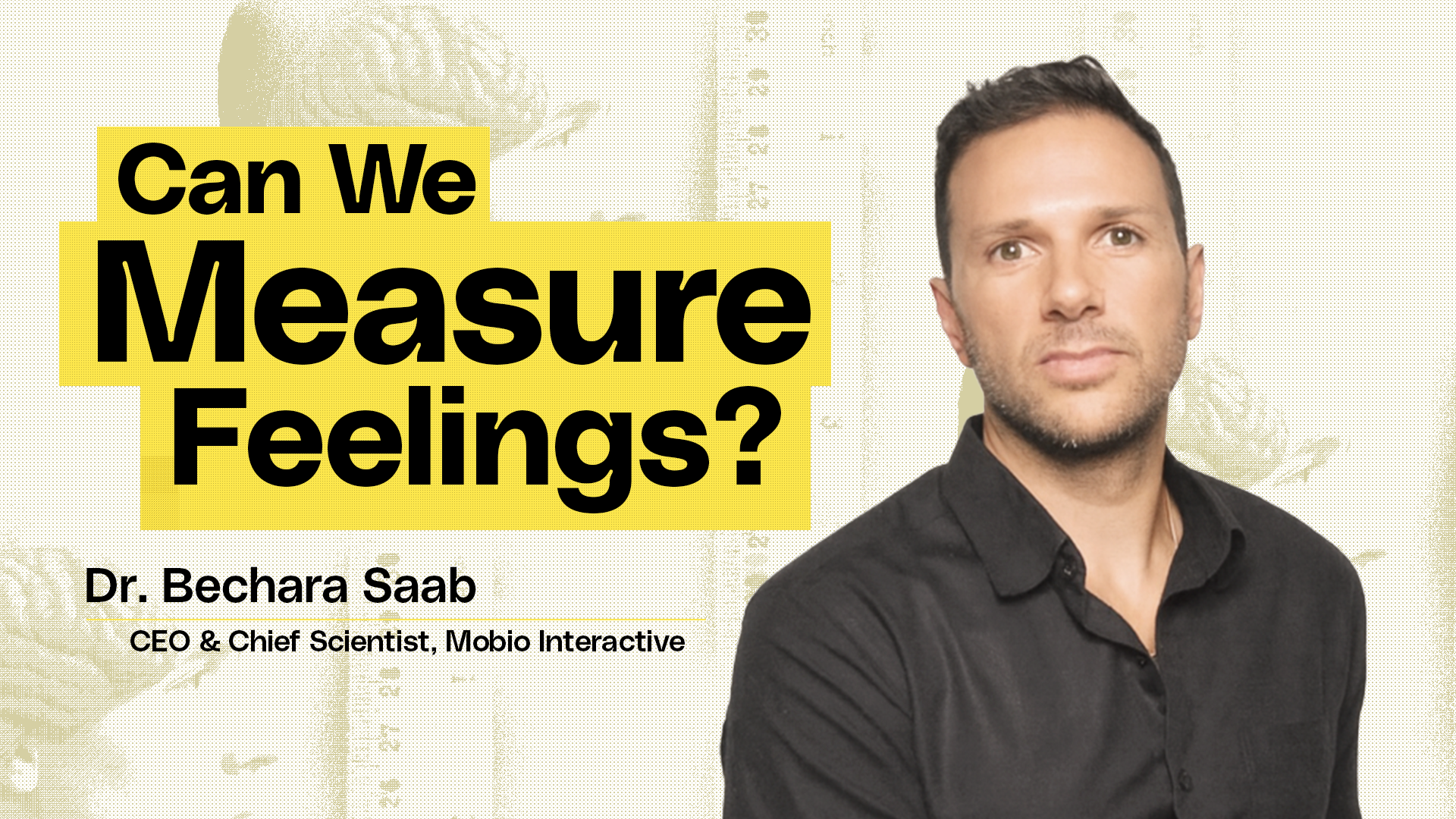
Psychiatrists have no objective feedback. Every other field of medicine does. Dr. Bechara Saab left his neuroscience lab at Zurich Psychiatry Hospital to fix that, and the data suggest he's onto something remarkable.
In this conversation, Dr. Saab shares how Mobio Interactive is bringing objective measurement to mental healthcare through over 1,000 psychotherapy sessions across seven languages. From proving mindfulness works via smartphone to using fMRI to show exactly which brain regions change with therapy, he's building the tools that clinicians desperately need but never had. We explore his journey from small-town surgeon's son to youngest research intern at Procter & Gamble to principal investigator in Zurich - and why he walked away from academic prestige to tackle the "greatest problem in mental healthcare."
💡What You'll Learn
Jonathan Nguyen (00:00)
Why would a neuroscientist give up a secure research career in Zurich to build a mental health startup in Asia? For Dr Bechara Saab, the answer started with an unexpected result. A clinical trial meant to test the limits of smartphone-based therapy ended up doing the opposite. It showed measurable improvements in anxiety and hinted that patients might respond to remote psychotherapy in ways that the researchers didn't anticipate. That finding became Mobio Interactive, a company now working with hospitals and Singapore's health clusters to bring objective stress measurement into clinical care. Saab argues that this system can detect stress more accurately than people can report it, and that even the largest tech companies would have trouble matching the dataset they've built. So what exactly did that early trial reveal? And how does a phone camera quantify something as slippery as stress? And why does Saab believe that this kind of measurement will reshape the future of psychiatry?
Jonathan Nguyen (01:08)
Welcome back to another episode of the Unsensible Podcast where we speak to the unhinged founders who are unpicking the chaos of the human mind. And today, one such person we're speaking to is Dr Bechara Saab, a neuroscientist who turned entrepreneur, who left a prestigious research position at the University of Zurich to found Mobio Interactive. And if this is your first time on the podcast, the rule of the podcast is you must pitch. Dr B, over to you.
Dr Bechara Saab (01:42)
Thanks, Jonathan. Pleasure to be here. Mobio is a company that we built in order to solve what I think is the greatest problem in all of mental health care and all psychiatry. And that is the use of objective measurement tools as standard practice in medicine. All fields of medicine have objective feedback that clinicians can use. That's something that we provide in the context of mental health. That means objectively understanding how people feel, how they respond to therapy. And we license this to hospitals, distribute through telehealth providers, and do a lot of work in expanding the care that clinicians can provide to patients all over the world.
Jonathan Nguyen (02:18)
Brilliant. So before we get into the tech of it all, I really want to get into how you went on this journey because you didn't start out as a typical 'I dropped out of Stanford to build a startup', right?
Dr Bechara Saab (02:29)
No, I didn't. Maybe I should have. Yeah. I come from a really small town, right? Small town – you don't get exposed to a lot of career options. Certainly not in the eighties and nineties when I was growing up. So I went to university thinking, what's the best job in town? Doctor, surgeon, like my father before me. But then I got exposed to research. First at Procter & Gamble – I was the youngest research intern at their facility outside of Rome, which is outstanding as an experience. But then as an undergraduate, when I did a thesis in synthetic chemistry, I fell in love with research. So creative, so much possibility to just explore your ideas, and incredibly challenging to the point of being humbling. And I just love that. And I thought, you know what, I'm going to do research instead, and I'm going to make discoveries and do inventions. And then that will have greater impact than I ever could helping patients one at a time as a physician. So I'm very much driven by impact.
So I didn't go to med school. In the end, I got a PhD at the University of Toronto in neuroscience, did a postdoc, and then opened up my own lab at the Zurich Psychiatry Hospital, which is affiliated with the University of Zurich, as you mentioned. And during that time, I felt bad for a lot of my colleagues that were on the clinical side. You know, I had access to this outstanding technology that allowed me to make definitive conclusions about how the brain works. And yet my clinician colleagues are making really important decisions with their patients without having access to the types of technology that provide objective information. That seems to me like a tragedy in this day and age when I know that we understand the brain well enough to measure it objectively.
So I got the ball rolling on that with a friend who I'd known for a very long time and he wanted to start a company – something in health and gaming – or rather quickly became an extension of my own laboratory. Simultaneous with creating the tools to quantify how people feel at scale, we also have to deliver the therapy, or be in the position to deliver therapy so we can show how these tools, when we measure the therapy, allow us to then deliver better treatment for patients.
We started with something which was pretty popular at the time. This is about ten years ago, which is mindfulness – a new emerging form of psychotherapy at the time. Getting a lot of traction. A lot of my colleagues were beginning to use it with their patients, but it hadn't been accepted as a treatment through an app. It was always done in person. And so we're like, okay, well, let's try to do this through the app. That's how we're going to be measuring these people.
And when I saw the results of our first clinical trial, which came in late 2016, where we demonstrated against placebo that in young adults with anxiety, we could reduce their anxiety symptoms relative to what we saw in the placebo group – that just clearly indicated to me that my potential for impact would be greater if I were to focus my energy on this newly founded company. Took about eight months to close my lab, send my PhD students to finish their theses with some of my colleagues, graduated the master's students. Then I took twenty days off and then it's been going full tilt since.
Jonathan Nguyen (05:08)
Back then you probably thought twenty days is like a really long holiday, right? I'll be lucky to have one soon.
Dr Bechara Saab (05:14)
You know, my whole PhD, I took two months holiday every year. One holiday that's a month long and then, you know, other vacations throughout the year. And I think that's about the right amount for a hardworking individual. Two months of holiday.
Jonathan Nguyen (05:28)
When I was in Australia, the work-life balance culture is a lot more balanced. Asia definitely doesn't, and definitely startup and running your own business doesn't quite allow for two months off.
Dr Bechara Saab (05:38)
No. But I'm hoping that we'll get there someday. Yeah. And I try to make it possible for my team as well. It'd be pretty hard to convince me that working twelve months a year is more efficient than working ten months a year, or more productive even, except in rare circumstances where you can do it in stints. But as a policy for a company, give them as much holiday as they want.
Jonathan Nguyen (06:04)
What was the moment that something happened that triggered you to say, wow, this has actually greater legs than I actually thought?
Dr Bechara Saab (06:12)
When you're a researcher, you mentally get the shit kicked out of you on a routine basis. You learn to doubt your hypotheses as a matter of course. I didn't have much faith in our ability to quantify how people feel. I thought it was worth trying. I knew it was theoretically possible. I didn't know whether or not meditation training through a smartphone, fully asynchronous on demand, extremely up to how the patient engages – I didn't know if that could meaningfully impact a patient's wellbeing. But on both counts, I was wrong. That's what encouraged me to keep going forward.
So I kind of treat the company in many ways like I treat my research problems, which is try to find the no as fast as you can. And as long as you don't find the no, you keep going forward and keep going forward. And that's changing a little bit now because the focus is less on research and tech validation and more mostly on commercialisation these days. That's really what made me dive into it – was just seeing that this stuff worked.
Jonathan Nguyen (07:02)
Was there a particular experiment, or did it just slowly build over time?
Dr Bechara Saab (07:08)
In terms of our ability to deliver meaningful therapy for patients, definitely there was the very first clinical trial that we did that was against placebo – that I thought was a Hail Mary experiment. I actually disagreed with our founding advisor, Professor Norm Farber at U of T, about the experimental design because I thought it was impossible to see anything unless it was a really strong effect. But lo and behold, we saw a really strong effect. Super exciting and really showed me that this is going to help a lot of people.
Jonathan Nguyen (07:38)
Talk a little bit about that. How does it work? What's the platform? What's the tech? Where did you start? Break it down for us.
Dr Bechara Saab (07:46)
Big question, lot of use cases. Imagine Spotify – it's an app that everybody's familiar with. You stream music on it, but in our case, you are getting access to audio files that provide therapeutic content. So we have a number of different therapeutic content. First, we started just with mindfulness meditation, expanded to other forms of meditation. Now there's a huge library – we're getting close to 2,000 asynchronous audio sessions across nine languages that we deliver for various different types of patient populations.
That Spotify experience is augmented by this ability to quantify how you feel, both subjectively and objectively, before and after you engage in therapy. So we get this pre-post measure. That's really the long and the short of it in terms of what the patient experiences. Now each patient has their own personalised path that they go through, dependent upon what particular mental condition they have, depending on where they are in the world and who they are. So the individual experience is always unique, but the general idea is, you know, it's Spotify with measurements on how that audio content is impacting you.
Jonathan Nguyen (08:32)
I mean, even ten to fifteen years ago, to put the words mindfulness and psychiatry together – probably it wasn't in the mainstream consciousness, right?
Dr Bechara Saab (08:44)
It was just getting there. I mean, part of the reason why we focused on mindfulness is because many of my colleagues were experimenting with their patients – just emerging in terms of its use case. And the original clinical studies that were done on mindfulness actually come from twenty years ago. It wasn't mainstream by any means, but there were certainly a lot of clinicians in the space that were paying attention to it and even beginning to use it, but not as an app – using it only in an in-person setting.
Jonathan Nguyen (09:08)
This might sound like a weird thing to say, but you know, even in research and in medical research, I feel like there are trends and fashions that come and go. There was a period of openness about experimenting with ideas like mindfulness, with psychoactive drugs, that all shut down. It wasn't research driven – it was kind of politically driven. Now we're kind of looking back at this research going, maybe there's something here. Do you feel like there are fashion trends that come in and out of the establishment?
Dr Bechara Saab (09:38)
Yeah, there are trends everywhere, of course. And if you can match those trends to stock prices, you can do quite well. In the 1950s in Canada, at least I think, psilocybin – magic mushrooms – was the standard of care in effect for alcoholism. And you're right, it was shut down for political reasons. Now it's coming back basically because the people who were trialling with it back then are now in positions of power and they've just climbed the ladder and now they're able to actually influence it. That's one driver of trends actually – just waiting enough time for enough people in power who are into this thing in order to start pushing it along.
So there's a few individuals – one of the most prominent ones was Jon Kabat-Zinn, who's often named as the one who really brought mindfulness to mainstream medicine. And he developed the mindfulness-based stress reduction manualised course. It's like a psychotherapy course, but it's really based on the tenets of mindfulness. And it has just exploded from there and it's used all over the place. And there's all different types of mindfulness and it's been demonstrated to work in all sorts of different conditions.
And then there's the broader just meditation space. Mindfulness is one specific type of meditation. People argue about how broad that definition truly is. I think mindfulness is mostly focused on this equanimity aspect – so being able to not have a negative or even positive reaction to something, but to just treat that information for what it is, to explore it for what it is, but try to keep the judgements away from it. That's an extremely powerful thing and hard to do. But once you get good at it, you've really, really changed the chemical nature of your brain.
Dr Bechara Saab (11:04)And to some degree, even the anatomical nature of your brain – mostly it's prefrontal strengthening over subcortical areas in your brain that would give you these knee-jerk reactions or emotional responses to things. Like we all know when you get angry and you're out of control – mindfulness prevents you from getting out of control, which can be really, really powerful. It can stop you from going through rumination cycles. It can stop you from getting obsessed with certain ideas. It can stop you from making bad situations worse. Usually when we're out of control, we're not helping the situation. Sometimes we are, but often we're not.
There's many other forms of meditation. Savouring, I think, is a really important one, which wouldn't traditionally be grouped in with mindfulness, but is often associated with it. You're really training your ability to notice positive things in your environment. You practise on neutral stimuli, essentially. There's a huge body of literature now which is understanding how these different practices specifically impact how the brain itself functions.
You think of your brain as a whole bunch of different muscle groups and you can strengthen certain muscle groups by training them. And when you do that, then you are stronger in that area. This is plasticity, right? Brain plasticity. And we can all use this to our advantage. And it's super exciting. And now I'm happy that it's accepted. It's something that a lot of patients will ask for themselves. It's like, 'Do you have a specific course for me to take while I'm getting my cancer treatment?' That's something that a patient wouldn't have asked ten years ago, but definitely something that they would consider potentially now.
Jonathan Nguyen (12:38)
I've come across a lot of mindfulness apps, coaching and counselling apps, but rarely from a neuroscientist perspective. Usually they're kind of like, you know, your yoga instructors and that type of mindfulness. It's interesting that now you're doing clinical trials and validating. What are the kind of hard results that you could talk about?
Dr Bechara Saab (12:54)
Yeah, we've done a lot of clinical work with some excellent partners around the world and we're very grateful for the clinical and academic partnerships that we have. We have evidence for a number of different indications – for those outside of the healthcare space, indication is our jargon for disease state.
Those indications include paediatric traumatic brain injury, or the emotional distress symptoms associated with concussion. It includes the fear of cancer recurrence for a cancer survivor, which is sometimes also described as post-cancer or cancer-related PTSD. We have clinical data for patients with a variety of different affect disorders – depression and anxiety disorders being the two main ones. We have data showing benefits even for people with substance abuse.
We're increasingly creating new courses – we call them journeys inside of the app. We create these new courses for different patient populations and we always validate them before we really release them out into the public. Although we are now exploring how we can do both simultaneously – really do the real-world data analysis, make it available to patients at scale. Since now we have a platform that has some reach, that's a feasible way to go about it. And then if we see something promising, then we can design a proper clinical trial to do that.
Jonathan Nguyen (14:02)
How are those trials conducted? Are you looking for an improvement in mental state, or are you measuring brain chemistry? How does that work?
Dr Bechara Saab (14:12)
The main way that you measure if a patient is getting better or worse in psychiatry is to give them what's called a medical instrument. It sounds like it's a physical tool, but that medical instrument is really just a series of questions. It could be like five questions, it could be thirty-six, and these questions could be multiple choice or open-ended or slider scale – a Likert scale type questions in this. 'How well do you agree with the statement?' Most of them are retrospective. So, 'Over the last two weeks, how many times did you lose your temper?'
These scales are really quite well designed to try to get to the truth by not asking people directly – what you're really asking them. Indirectly ask for things which are behavioural things or experience things that are associated with the sentiment or the trait about how somebody's feeling and doing mentally. And they're really quite good, but they have huge limitations. But that's the primary way that we quantify whether we're having an effect in these patients, using the exact same tools that the clinicians would use even for the diagnosis process.
Another way that we do it is through fMRI. So we have preliminary data where we're demonstrating the impact of delivering our psychotherapy asynchronously to patients remotely in a highly scalable way. We're demonstrating how it impacts brain function. And this is in kids post-concussion. It's super exciting work to get this functional magnetic resonance imaging data on these kids. That's showing us the mode of action or the mechanism of action, right? Both terms are commonly used.
That's the kind of thing that pharma companies will do. Like, here's this drug, here's this disease. This is biologically what we think is going on. And here's the data to back it up. And that's the kind of thing that we're doing now. These types of papers are really important for our field because it removes doubt better than anything else by providing that understanding. When you can actually demonstrate what parts of the brain are being impacted by the therapy, it's irrefutable. And it's the exact same thing for drugs.
You get a drug and you say, oh look, their tumour went away. That's great. But everybody can always be like, yeah, but maybe it was because it just naturally went away – their immune system kicked in and took care of the tumour or whatever. But if you can then say, but this molecule did it by acting upon this specific receptor and it shut down this erroneous growth pathway – it's irrefutable. As long as the evidence supporting that mechanism is good. Sometimes it's not, you know – there are drugs on the market where the mechanism I think is wrong. You know, there's data that support it, but the data aren't good enough for me as a neuroscientist to agree with the conclusions that are claimed by the drug companies. And that's fine. It's part of science. It's part of how things work.
Jonathan Nguyen (16:42)
There's a very funny thing that, as a marketer, I instinctively understand. You can put completely irrelevant correlations on screen, and if you've got a brain glowing in a certain area, everyone goes, 'Look, brain glowing here – good. Brain not glowing here – bad.' Everyone understands that.
Dr Bechara Saab (16:58)
Marketing's a beast, that's for sure. Something that I am now paying much, much closer attention to compared to in the past, because that's the stage we're at now. Our stuff's validated. We know it works. You know, what we're doing is so fundamentally effective in terms of the therapy that it's going to help virtually anybody in any situation.
We have been so cautious as a company in how we've commercialised this technology. And only really now are we starting to let third parties integrate it into their systems because we know we've worked out the bugs. We can quantify psychological stress, I think, better than any tool that's ever been invented. Stress is an incredibly good proxy for your overall mental as well as physical wellbeing, and we can get it objectively. Doesn't matter what the patient thinks. They can tell you they're not feeling stressed. If this thing comes back and says they have a high stress level, and if that high stress level is maintained over time, those are the data you need to trust. That's the reading that matters. Screw what they think about themselves. Sounds crazy to say, right? And it's scary. We can get into the philosophical ramifications of this type of thing, but that's what the data show. And that's very, very important.
Jonathan Nguyen (17:51)
So talking about marketing and distribution – your route to market at the moment, you're going through hospitals and clinics, is that right?
Dr Bechara Saab (17:58)
We are a B2B company. This model emerged kind of for two reasons. One, as somebody who grew up in Canada with universal medicine, I kind of just feel like this is healthcare – people should be able to get access to it irrespective of their ability to pay. I just think that that's – I don't know – polite, kind. I don't know what word you want to use to describe how I think the world should work. Humane. Humane is a good one.
But we really wanted to work on, how can we make sure that the patient doesn't have to pay? Or rather, anybody can use it irrespective of their ability to pay. So let's integrate it into the healthcare economy. To me, that was very important.
But also, even before we were pushing for commercialisation, some of our clinical partners were discussing – and the stuff's getting out and people can see that it's effective – and all the clinicians were like, 'Can I just use this thing?' And I'm like, well, I guess we could set up a licensing agreement, you know what I mean? And that's just kind of how it emerged – was demand from the healthcare, the hospitals, right? These early adopters. And so, you know, it was a matter of working out some of the financials, et cetera, but we still work with all those initial hospitals. Truly partners of ours, indispensable for our growth.
Now that being said, we have always been open to people paying for our software, and I've made that available. So we had a subscription. Now we've got rid of the subscription system. People can buy special content that they want to support what we're doing and they want to get access to that stuff. But it's such a small proportion of our revenue that we don't even include it in our financial modelling.
There's already a lot of misalignment in the healthcare economy. And so I don't want to just make things more complicated, more difficult. I want to help bring things together and align the patient, the clinician, and the solution provider together. It's very difficult to do, but when you have a startup, you can do whatever you want as long as you keep the lights on.
Dr Bechara Saab (19:35)
Private companies in general, right? We don't have shareholders, all that kind of stuff. But the reality is you can explore a lot of different business models that you wouldn't be able to explore if you were a big publicly traded company. It's easier for us to solve this problem than it is for the big four pharma companies.
Jonathan Nguyen (19:52)
It's very hard moving a giant machine. I talk to founders like you and we can propose ideas that to me are normal – to you it will be like, yeah, this will get some noise, we'll get some cut-through with this provocative position. But at the same time, on the other side of the fence, we have some very blue-chip, let's say, tech companies. They're no longer at the size where they can turn around and say certain things, get airtime – they're just in a much more conservative position. Even the decisions they make, there's a much bigger geopolitical reason why we can't make this very sound commercial decision. So as a small company, it's a different story.
Dr Bechara Saab (20:28)
That's why alignment is so important. But these big companies, particularly in healthcare – most, if not all of them – make more money the more sick people are. That's a stupid way to set things up. I mean, you're just asking for trouble. When you've got that profound of a misalignment with something so incredibly important to our lives – if we work together, particularly the startups that are entering the space and growing, if we're able to figure this out, if we're able to make more money the healthier people are, you know, we can make some change. Because that alignment, I think, is far more powerful.
Jonathan Nguyen (20:55)
So why Singapore?
Dr Bechara Saab (20:58)
Singapore's an interesting story. When I left the lab in Zurich, my co-founder Mark Thobrin was in Toronto. He was originally CEO and I was just an early investor and an advisor. And I, in some ways, commandeered his company. He's not even in the company anymore. We still are good friends.
He was speaking with this investor that many people will know – SOSV. They cut small cheques to very early stage companies and they can cut larger cheques as follow-on, but only to those companies they originally invested in. In addition to giving money, they run an accelerator programme. You show up and they'll teach you how to run a business. That's super appealing to somebody like me who's coming in as a neuroscientist.
And so SOSV decided to make an investment, but they did it on the condition that we made a play in the Chinese market. And Mark and I were like, look, we can both be in the same city. We went to Shanghai together for this accelerator programme. And it was great. It was super intense. Mark and I were working together building this thing.
And we made a transition where I became CEO, mostly because I had more experience in this space. And that was the primary feedback we got from our investors. Not the easiest transition to make, as you can imagine. The suggestion came from our investors. I brought the idea to Mark and I was like, look, I was talking with them and this is what they think. At this stage in the company, I would be a more appropriate CEO. Mark looked at me and he said, 'Not happening.' And I didn't say anything after that. Nothing. And I think we were touring around – we were in Beijing or something.
At one point in time, I was sitting down on the bus and he came and sat down beside me in the empty seat and he looked at me and he said, 'Okay, we're going to make this happen. We've got to make sure the lawyers do it right.' And I knew exactly what he was talking about, but we had not spoken about it at all. But then I guess he reflected on it and he said, what's the right decision? Because I built the product – we need you to build the company.
You asked me about Singapore, right? Okay. So a few little stories along the way. At the time, the relationship between Canada and China wasn't fantastic. We thought it would be more strategic – and it's also much more flexible – to open up a holding company in Hong Kong and use that to create our entity in China. Because remember, we got this money, we got this investment on the condition that we make a play at the Chinese market. So we're going to go for it.
Then in 2019, 2020, there was some political instability. Things were going down. We were getting a little bit uneasy with Hong Kong and we had more traction actually outside of China than we did in China. So China was becoming sort of less important. By this point, our investors didn't really care where we were based, you know, as long as we were doing well.
We kind of looked around and it was pretty obvious that Singapore was a great place to do business. They do business with anybody, basically. But in addition, we were doing our seed raise and the two lead investors happened to be based in Singapore. This guy, Tony Estrella, who I met through those SOSV investors – he was the guy I wanted to tap to be our first chairman. We officially set up a proper board after the seed raise. He was living in Singapore at the time. So it just kind of made a lot of sense. And I even moved myself there to be in Singapore. And we haven't looked back. Great place to do business, beautiful city. We work very closely now with two of the health clusters in Singapore and increasingly with the government as well.
Jonathan Nguyen (24:02)
In business, actually, it's just about predictability.
Dr Bechara Saab (24:06)
Predictor of success of a nation or organisation? Well, nations in particular – is it predictable? Right? Is it stable? Can I make a twenty-year investment?
Jonathan Nguyen (24:17)
Most of what you guys do in research is being kicked in and out by data. Especially in the early days, it probably wasn't easy, right?
Dr Bechara Saab (24:24)
Yeah, we have a couple of failed clinical trials under our belt and we've got a ton of deep tech work that went nowhere. I love that. I love that we're so far along. We're sitting on the edge – and once in a while we fall right off.
Jonathan Nguyen (24:38)
A lot of founders I speak to find this job quite lonely. It's quite hard. A lot of them have thrown – perhaps their families have made a bet on their career on this. And there's this just constant pressure to achieve and perform, and then failures are not always relished. There's a really interesting intersection of increasing stress handling and then the desire for more stress. You sit at this intersection where you're a founder but also the mental health guy. How do you handle the added pressure there? You know, my investors say that you cannot burn out – you burn out, the company's toast.
Dr Bechara Saab (25:12)
I've seen it. When us founders get together and have private conversations, it's quite revealing. I don't know if lonely is the right word, but founder CEOs, I think in particular, yeah, really have that pressure.
I take that stuff very seriously. I practise what I preach, right? I mean, I use my app as a psychotherapy tool for myself. And that has profoundly increased the quantity of stress that I can take. I think I also naturally understood that it doesn't make a lot of sense to worry about things you can't control. There's a thousand and one different techniques and principles that I have to handle this.
The loneliness, or you know, the difficult struggles and things you can't share or wouldn't be wise to share publicly – I think that, more than anything else, is very interesting. But look, I mean, nobody forced us to do this. And I truly believe that everybody has struggles, regardless how great things look. And if you just remember that, you know, then I think that can also release a lot of pain because it allows you to understand a little bit why people do the things they do, or what could have made them do that. I can just say like, look, the benefits far outweigh the negatives for me.
Jonathan Nguyen (26:12)
When people ask, 'What's your advice to new founders?' – the advice I keep hearing over and over again is, 'Don't do it.' It's actually implicitly the right advice. And the reason I say that is the people who shouldn't be doing it won't do it, but the people who just have to do it because of an overriding need to do it – they're just going to do it anyway.
Dr Bechara Saab (26:32)
And that's the drive you need to succeed more often than not. Look, there are so many things that surprised me about this journey. I was shocked about how similar a startup is to a research lab. First off – well, certainly a deep tech startup, right? You're on the edge of technology. You're dealing with people that are impact driven. There's more concern about impact, and let's say ego and recognition, than there is about money early on. Lots of different personalities, because you're pulling world experts from around the place, and so they're probably going to be diverse. It shocked me that people will give you millions of dollars.
Dr Bechara Saab (27:09)
It shocked me just how little respect I have now compared to being a principal investigator at the Zurich Psychiatry Hospital. That blew my mind – when I gave up that title and then I'm 'neuroscientist turned entrepreneur'. I'm a guy who gives a shit. Principal investigator at the Zurich Psychiatry Hospital – 'Oh, Dr Saab. Oh, nice to meet you.' When you're a prof, everybody understands that you worked your arse off to get there. But when you're the founder of a startup that's like four or five years old, nobody has any idea how hard you've worked just to keep that thing alive. I guess that contributes to the loneliness.
Jonathan Nguyen (27:38)
When I discovered the Stoics many, many years ago, that actually works inside your own mind as well. The person that it happens to tells themselves a particular narrative. But if that thing happens – like if they tell themselves a different narrative – actually it's not so bad.
Dr Bechara Saab (27:52)
You know, it's true. I think a lot of affect disorders – and this is not a popular thing to say – but it is a lot about point of reference or viewing. I think affect disorders are primarily dysfunction – although that's not the precise word I want to use. It concerns the prefrontal cortex more than people appreciate.
Jonathan Nguyen (28:08)
Describe the function of the prefrontal cortex.
Dr Bechara Saab (28:12)
Basically, the prefrontal cortex is where your conscious experience and your awareness allow you to take action. So you can process information in your prefrontal cortex and then send signals to the rest of your brain to actually get something done. You know, your volitional control is guided by your prefrontal cortex, your decision making and all that stuff. So it's an extremely important part of the brain and it's also how you problem-solve, how you internalise things.
I think when somebody has depression, very often it's due to how they view a problem. You can take two people and have the exact same experience and one, you know, walks away with depression and the other one doesn't. I don't think the difference in that is as impacted by subcortical regions as it is by cortical regions. And even if it is mostly impacted by subcortical regions, your cortical regions – particularly the prefrontal cortex, PFC – have the ability to influence it.
So, you know, the primary drugs that we have to treat affect disorders – SSRIs, tricyclics – they all operate on these neuromodulatory transmitters in the brain: serotonin, dopamine, et cetera. The real success comes from computational change in the prefrontal cortex. That's what you get from psychotherapy. That's why psychotherapy has such a lower remission rate compared to when people stop taking these pharmacological solutions for affect disorders. That is the strongest evidence that I can think of to describe why the narrative is actually the most important part of your experience, medically and non-medically. It's the stories we tell ourselves. They are profound.
Jonathan Nguyen (29:48)
Let's switch gears a bit. What I like to ask CEOs and founders is: what productivity tools do you use?
Dr Bechara Saab (29:56)
There are the tools for the team and there are the tools for myself. So for the team, we just use Jira to manage the tasks on the development side, even on the deep tech side.
We used to have this tool that I built myself, which quantified synergy. And so I set up a system where people would track what tasks they were doing, how much time they were doing it. It was relatively easy to use. It was very manual. The reason why I liked using it in the earlier days is because it actually really quite clearly showed us what were our most efficient things. You know, the 80-20 rule – it was a great way to identify what's the twenty per cent.
That worked really well. And the only reason why we stopped using it is because we went through a cash crunch. In that environment, I was like, I'm not going to harp on people to fill out this information about what they're doing. And now I think it's just sort of second nature for most people on the team to really just focus on the most important stuff.
And the main thing that I think came out of that entire process was: you set your priorities at the beginning of whatever period – a week or two weeks – you do the first priority. Like, you don't even think about it or anything. That's what you do. The high-priority stuff, you decide in advance, often with other people. That's what you do. And I think that really came out of it – is that discipline to do what matters.
Jonathan Nguyen (31:02)
What does the next five years look like?
Dr Bechara Saab (31:06)
Well, one thing I think is going to be true in healthcare across the board is people will expect to use intelligent chatbots or AI agents as a way to navigate software. Like, it's already going to become sort of instinctual. I can just say, 'Hey, how do I do this thing?' And then it tells you. So I think that experientially will be something that people really want. The ubiquity of these AI chat agents is only just beginning.
I think the industry is going to, in the next five years, meaningfully embrace objective tools for how people feel. I think the time is now. We're ten years into this game and now we're reaching a turning point where we and others have done enough work to show that this shit works – and it works better than what we currently have. We have a demonstrable improvement in how we measure the effectiveness of treatment. That is so valuable.
Dr Bechara Saab (31:44)
Not just for the patient, but everybody in this space. And I would venture to say that five years from now, it would be considered a faux pas to not at least provide the option, or try to have the option, to include an objective measurement of some kind in any patient's journey with respect to mental health – even if it's dealing with the mental health comorbidity associated with another disease like cancer, et cetera. That I think is upon us. And I couldn't have said that and wouldn't have said that five years ago, but I can say it now.
Jonathan Nguyen (32:08)
Do you think that the ubiquity of the agent means that your app and other apps like yours will have their own agents, or do you think there will be one omnipresent chatbot – a ChatGPT – that you guys will plug into?
Dr Bechara Saab (32:22)
In terms of that change in how people experience digital products, where they expect to be able to ask an agent the question that they're thinking in their head – that I imagine will emerge out of the big chatbots. OpenAI or Gemini will have a version. So Android will probably have something that you can just throw into any app, like a keyboard. I think that's how it would be most likely to work.
And that's what we're trying to do with our technology as well. I'm increasingly interested in other companies using our tools – not our platform. We have a patient-facing psychiatry platform that integrates with EHR, all these different use cases, takes care of patients on wait lists, does triage treatment, engagement, releases, you know, Class II software as a medical device courses – does all this incredible stuff.
But the tool that we use to quantify stress – that's something that I want other people to really just embed into their system. You know, you're not going to be able to build something better than what we have. We're way ahead of the game in terms of the size of the data and the capacity. I mean, even I think it would be a struggle for the big tech companies to catch up to us – which is a very bold claim and maybe sounds a little arrogant or naive even.
But the reality is, you know, we've taken a different approach and we're years ahead. So it'd be hard for anybody to catch up because it would take them some time to get to where we are now. But by then we're not there anymore – we're further along.
Jonathan Nguyen (33:39)
They probably want to buy you more than try to catch up, like…
Dr Bechara Saab (33:44)
They don't need to catch up. Just get out the chequebook – or a briefcase or whatever.
Jonathan Nguyen (33:50)
I've got a few questions for a lightning round and I want you to just spit out what's the first thing in your head without having to filter like the thoughtful ex-researcher that you are. Okay. If you could measure any aspect of human consciousness with a phone camera, what would it be?
Dr Bechara Saab (34:00)
The illusion of free will.
Jonathan Nguyen (34:03)
What mental health myth drives you absolutely insane?
Dr Bechara Saab (34:05)
The idea that people are either introverted or extroverted.
Jonathan Nguyen (34:10)
Interesting one – we need to talk about that another day. If you weren't running Mobio, what scientific question would you be pursuing right now?
Dr Bechara Saab (34:18)
Jesus, that's a tough one for a lightning round. I'd be doing what I'm doing now, just in an academic context. You know, I started out in chemistry, then I was doing learning and memory, which is a great foundation – a way to begin a neuroscience career. I made a discovery on how curiosity drives the learning process. Then I became interested in how curiosity is linked to mental health, because people with mental health issues have either a reduced drive to explore or just generally engage in exploratory activities, you know, much less often. Probably I'd be doing that – cooler and cooler experiments.
Jonathan Nguyen (34:48)
What album have you got on high rotation right now?
Dr Bechara Saab (34:51)
There's this artist, Clara Cruz – she's a Portuguese artist – and she's got one song. I don't even know the title. She's singing it in French and Italian and it's awesome. It's got such a great guitar solo and I've listened to that I don't know how many times and I just can't get enough of it. It's not an album, but I mean, come on – it's 2025.
Jonathan Nguyen (35:08)
I get it. I get it. I get it. Old-school question. All right, dude. That was it. Thank you very much.
Dr Bechara Saab (35:14)
Thanks, Jonathan. Happy to come back anytime to discuss some neuroscience ideas or philosophy or any other aspects of business. Pick my brain on neuroscience stuff and really get into like neuroscience. Happy to do that. Thanks, Jonathan.
Jonathan Nguyen (35:28)
All right, Dr B, thank you very much.