.gif)

PODCAST
How Flagright uses AI to keep your money safe | Baran Ozkan, Flagright


{{big-quote}}
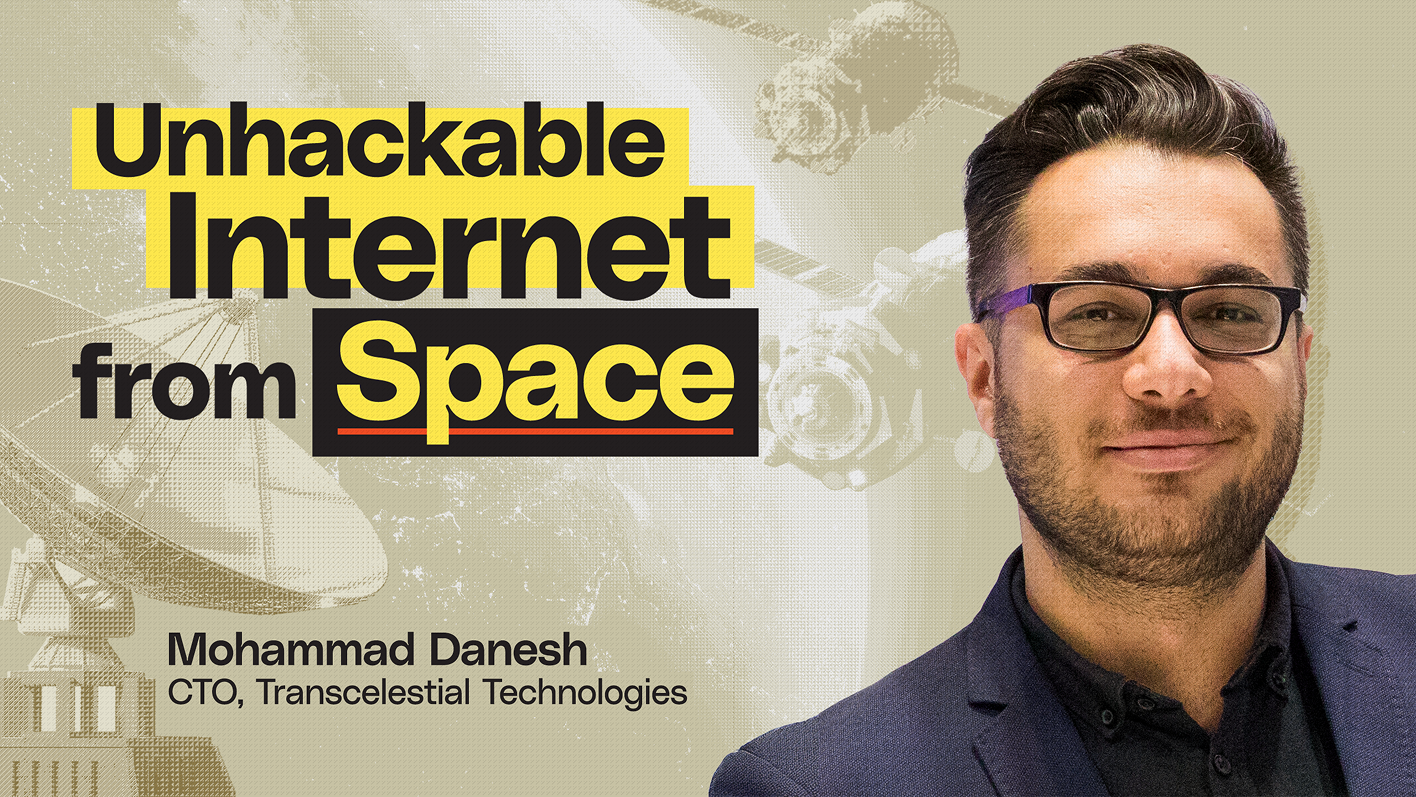
We use the internet every day, but 99% of our data relies on fragile, undersea fiber optic cables that are completely unprotected from accidental cuts or deliberate sabotage. Dr. Mohammad Danesh, co-founder of Transcelestial, is solving this global security threat by building an unhackable internet backbone using high-bandwidth space lasers.
💡 What You'll Learn:
Jonathan Nguyen (00:00)
We use the internet every single day. But do you actually know where your internet comes from?
Dr. Mohammad Danesh (00:04)
You'll be surprised a lot of people think it comes from space.
Jonathan Nguyen (00:07)
It doesn't. 99% of the world's data travels through fibre optic cables buried under the ocean. And those cables, they're being cut. By anchors, by ships, and sometimes on purpose. In 2024 alone, cable cuts in the Red Sea knocked out a quarter of the internet traffic between three continents. Investigators of another cable cut in the Baltic Sea have labelled it sabotage.
Dr. Mohammad Danesh (00:28)
And it's all public information. And there's nothing in the ocean that's actually protecting them or doing anything about it.
Jonathan Nguyen (00:34)
Replace those cables with lasers. That's exactly what Dr Mohammad Danesh and his company Transcelestial are building: a laser communication network that works on the ground and in space. Last year, they launched their satellite on a space
Dr. Mohammad Danesh (00:49)
rocket. Imagine 2016 in Singapore talking about space lasers.
Jonathan Nguyen (01:03)
Welcome back to another episode of the Unsensible Podcast where we speak to the space cadets who send lasers to space. Today, I'm talking to Dr Danesh and we're going to hear a little bit more about his company Transcelestial. Dr Danesh, or do I call you Moe? What am I calling you for this podcast today?
Dr. Mohammad Danesh (01:25)
You can go with Moe.
Jonathan Nguyen (01:27)
Moe, this is your first time on the pod. We have a rule: the first time on the pod, you've got a pitch. I'll hand it over to you.
Dr. Mohammad Danesh (01:33)
Thanks for having me today. At Transcelestial, we're trying to connect the 1 billion people in the world still not connected to good, high-quality internet. The way we want to do that is to use lasers. How does that work? If you look at the problem we're facing around the world, 99% of the world's data is currently going through fibre optic cables. But there are still so many people not connected to the internet yet because cables are difficult and expensive to run. The places not connected yet could be geographic limitations: underwater, islands, mountains, et cetera. On the other side, day to day, our last point of connectivity is wireless, through our phones, through our wireless routers, et cetera, because they're very flexible. However, they are inherently limited in the amount of bandwidth they can send and receive; they're congested due to limited spectrum. What we're doing is trying to get the best of both these worlds. We're taking the laser from inside a fibre optic cable and sending it wirelessly. That's where laser communications comes from, so you get extremely high bandwidth with really high flexibility. The opportunities are limitless. You can connect people inside a room, from one side to the other, inside a house through things like LEDs and light bulbs, across locations in a city from one rooftop to another. You can go all the way into space, from ground to satellite, satellite to satellite, and satellite to deep space, to moon, to Mars.
Jonathan Nguyen (02:56)
What's your background? How did you decide to get into such a deeply technical area?
Dr. Mohammad Danesh (03:02)
I was inherently a nerd and I knew that from young. I went the route of studying electrical engineering, and from very young, I was fascinated by electromagnetic waves. My background was initially in RF and microwave systems, which are your traditional wireless communication systems, which I also found really, really interesting. But there's already been a lot of work done in those areas; it's quite well-developed and quite mature. The cool place a lot of research was happening was in the optical world: photonics, optics, nanophotonics. That's when I decided I was going to go into the nanophotonics world. I joined the PhD programme at the National University of Singapore. I got a bursary from the Singapore government, which connected me to A*STAR, which is a research institute there. I was fortunate to work on one of the most exciting research areas of that time, which was the combination of nanophotonics – basically, the interaction of light with materials on a very small scale. The material interaction I was looking at was graphene, which is also a really fun new material that had come up.
For the audience who may not be familiar with what graphene is, the tip of a pencil is made out of carbon. You have graphite there. Graphite is basically made of pure carbon, carbon arranged in layers. If you take a single layer of that carbon away, it's basically graphene. Funny enough, the way it was actually discovered was just as simple: researchers in the UK basically just looked at a small piece of graphite with Scotch tape and kept peeling it and peeling it and then peeling it and putting it under a microscope. From the colour of the interference I was seeing under my microscope, this looked like it might be a single layer of carbon, which previous to that, science believed was impossible to exist – that it wouldn't be a stable structure. But then suddenly they noticed it does exist. They won a Nobel Prize for it. So, at that point in time, graphene was a super interesting material. My PhD was the interaction of light with graphene and very small nanostructures, which was really cool from a science point of view. I enjoyed that, but I'm also a very practical person; I really want to see the impact of what I'm doing in the real world. There was some point in my PhD that we would work on a topic, do a lot of research simulations, and then try to draft a paper, going back and forth for reviews. I'd be like, 'Prof, what do we do next? Why don't we make a little device? Let's see if we can make something.' They'd say, 'Hey, no, no, no, we're going to the next topic now. We're publishing our paper. Our job is done.'
Jonathan Nguyen (05:22)
Pure academics, right? It's a different game.
Dr. Mohammad Danesh (05:25)
There's nothing wrong with it. At that point in time, it was maybe a little bit frustrating and it didn't make any sense to me. Why aren't we trying to now do something useful with this? Why just publish and leave? Now I'm able to explain it through Technology Readiness Levels, TRL levels. If you're not familiar with the term Technology Readiness Level or TRL, it's basically a scale that you go from one to nine to define how new or mature a technology is. TRL levels one, two or three mean you're talking about things which are very conceptual, theoretical, analytical. Basically, it's an idea; we're doing some theoretical analysis, we're doing some simulations. We're going to write a paper about the potential of it. If you're talking about the space industry, a demonstration of a working product in space is TRL-9. In academia, you're usually working on lower TRL level concepts. This can be really fun if you love exploring many topics and moving on to new ones, exploring and letting other people deal with the headaches of trying to make it work in the manufacturing and all of that. But if you're someone like me, who's not patient enough to wait for someone else to do it, and you love this thing that you worked on so much that you want to be the one who takes it all the way, then you probably have to also step a little bit outside of academia. I have explained it to them a few times.
Jonathan Nguyen (06:38)
Do your parents know what you do?
Dr. Mohammad Danesh (06:42)
I think on a very high level they do understand it's about connectivity and we use lasers to connect, and we've got some stuff maybe happening in space and sometimes on ground. I think I've managed to get the 'Mum pitch', right?
Jonathan Nguyen (06:55)
How far into this journey are you now?
Dr. Mohammad Danesh (06:58)
Long story short, 2016 is when I graduated and I got an email from some people called Entrepreneur First. We were the first batch. No one in Singapore knew of Entrepreneur First at that point in time. I basically left the Cambridge plants, joined Entrepreneur First, and we started the company in 2016. After eight years, what I can claim is that for our laser communication product on the ground, Centauri, which can send up to 40 gigabits per second up to three kilometre distances, we have been a TRL-9 product for a few years now. We have been manufacturing Centauri at scale and deploying it commercially all around the world. So, I think we're quite far from a technology development perspective. For the ground product, where we are from a commercial perspective is now fighting for adoption. That's the next phase. We've proven the technology works. We've proven the technology is scalable. Now we're trying to get it adopted by the major telecom companies around the world. We've been working with the likes of Telkom Malaysia, Telkomsel Indonesia, Globe in the Philippines. These are major carriers in the region. We've been working with these guys for a few years. We've gone through multiple stages of trying something, testing something in the lab, taking it to do a pilot, then putting it in a production link. Now, let's try a dozen of these in a certain area. Each of these stages can take six to 12 months. We're now at a point where we're talking about massive, major, large-scale adoption of the technology.
Jonathan Nguyen (08:25)
have internet on their mobile and they call it the Wi-Fi. But I guess there are a lot of components to it to deliver that internet to your phone, right? Let's break that down a little bit so that people get a feel for how challenging it can be.
Dr. Mohammad Danesh (08:37)
Let's start from the experience of the end user, like you and I, sitting at home or somewhere outside with our phones on us. We use 4G and 5G to connect to the internet. Where does this come from? You'll be surprised: a lot of people think it comes from space and from satellites. It doesn't. 99.9% of the time, your 4G and 5G wireless signals are coming from cell towers within a few kilometres' radius of you. A lot of people may not even notice this, but depending on the city you're in, these big rectangular antennas, pieces of metal sitting on the sides of tall buildings on their rooftops, or sometimes just sitting on these towers, this is where your 4G and 5G is coming from. Now, where do these get their internet from? They are all connected to your fibre optic infrastructure in your city. For most of these 4G and 5G towers, you need a gigabit per second backhaul. This backhaul traditionally comes from fibre optic cables. Depending on what city you're living in, there's very likely an extensive network of fibre optic cables connecting all the major locations in the city where these nodes are set up. If these fibre optic cables are already in place, it's great; they're very easy to upgrade. Unfortunately, the reality is, in a lot of cities, especially those which are geographically vast and complex, these fibre optic cables may not exist. There are also new populations of people being set up that need new cell towers. For example, for 5G to become widespread and useful, we need to increase the density of our cell towers by around 10 times. Every single one of these cell towers needs a fibre optic cable. That's when things become complicated because sometimes putting up a fibre optic cable to a new location can take years of planning, permissions, and sometimes...
Jonathan Nguyen (10:18)
to the ground.
Dr. Mohammad Danesh (10:19)
Right. And not just normal cable, you have to go through roads, through buildings, multiple permissions from municipalities. What we're doing is replacing the need to bring a physical fibre optic cable using a laser link to backhaul those cell towers and get those cell towers that you get your internet from connected to the key networks that can bring data to them.
Jonathan Nguyen (10:40)
I used to be in the telcos many, many years ago and we were on a different technology stack. We had copper to link cities and copper used to get stolen all the time.
Dr. Mohammad Danesh (10:50)
Jonathan, you'll be surprised, it still happens in some places. People also by mistake sometimes steal fibre because they think it's valuable.
Jonathan Nguyen (10:58)
You had a lightbulb moment and thought, 'There's a problem here I can fix.'
Dr. Mohammad Danesh (11:02)
We started the whole company on the idea of using lasers to connect to space. That's where it all began. In space, there are no cables. 99% of the world's data on ground goes through fibre optic cables. So, there's so much data being collected in space that we don't know what to do because we're limited by the wavelengths, the spectrum that we can send and receive data in space. It's extremely congested. My co-founder and I were sitting at a New Space conference at NUS in Singapore, and there was a talk about the new generation of nanosatellites. By the way, for the audience, a nanosatellite isn't really that small; anything that's in the order of a few tens of centimetres is more or less what's called a nanosatellite. I remember asking, 'What's one of the biggest challenges?' Data. You can collect so much information now with the great sensors you have, but you can't send that data back down. The idea was that lasers are a perfect solution here. They are wireless. They can be easily deployed in a space environment and they can increase the bandwidth by more than a thousand times. It's a no-brainer. That's where everything began. Our big vision has been, from the beginning, to build a global network – a constellation of satellites that are in space and use lasers to connect in between themselves, back to the ground, and further into space. So, a fully laser-equipped backhaul technology that runs from space not only allows connectivity from anywhere, anytime, anyplace, but can also, in some places, complement or be a backup to a fibre optic cable. Fibre optic cables can be taken down and they don't necessarily have a lot of redundancies. If you look at places like Singapore, Australia, or other places around the world which have a lot of water borders, anyone can go in and see how many fibre optic cables are coming in and out of these countries. It's a vulnerability. If these cables go down, some of your infrastructure, your whole country, is disconnected from the globe.
Jonathan Nguyen (12:50)
I think most people don't realise the likelihood of a global world war is probably unlikely even given the current leaders. Actually, you don't need to go to war. A country like Australia, how many cables would you have to cut to completely decimate the economy? Probably not many.
Dr. Mohammad Danesh (13:06)
It's all public information. There aren't many of them and there's nothing in the ocean that's actually protecting them or doing anything about it. Let's look at Australia, for example. We need satellite connectivity as a backup to undersea cables. Obviously, satellite connectivity doesn't have the right amount of bandwidth, but even putting that aside, it's still not immune to other techniques. If you're sending data from a satellite to the ground with a radio link, you're going to have a footprint of easily a hundred kilometres or more. If anyone can be within that footprint, they can listen to what you're doing. We all know encryption is not unbreakable, right? If we actually want to connect those locations with a secure link, we can't because the footprint of that radio beam is also going to go into international waters. Anyone could just have a little boat and listen to that information. Not only just listen, but also jam them. That's where lasers offer not only a really high bandwidth connectivity option, where you get more than a thousand times more bandwidth available, but also one of the most secure ways of connectivity, because you shrink that multiple hundred-kilometre footprint to something that can be around a hundred metres or so. Now, you can physically limit access to that data.
Jonathan Nguyen (14:16)
Definitely, there is a place for military government backhaul. We're probably a bit far away from me putting a dish on the top of my apartment and getting internet from a laser. What do you think?
Dr. Mohammad Danesh (14:29)
Right now, if someone wanted to connect to a laser beam in space, what you need is an optical telescope. So, in space, there's something like an optical telescope sending the light to the ground. On the ground, you also need a nice big optical telescope to collect all that light. It's not super expensive, but it's still much more expensive than your traditional RF communication technology. So, it's still not competitive from that perspective, unless it's a specific application where that application requires security.
Jonathan Nguyen (14:56)
You've got to track it across the sky, right?
Dr. Mohammad Danesh (14:58)
Yes, exactly. If you're in LEO orbit, every satellite will be going around the Earth maybe 10 or 15 times. So, from the moment, let's say I'm sitting here, for example, in Singapore or Perth, and I'm looking at the horizon and the satellite starts showing itself up, it's around 10 minutes until it's on the other side of the horizon. If you want a really high-reliability link that doesn't have any downtime, you probably need two of these tracking systems that work concurrently and do smooth handovers. That's why it's a little bit more expensive and difficult for a home user. Where do we need to get to for this to become something as common as the technology that we have for everyday use? What needs to happen there? One, we need to get away from mechanical steering and go to electronic steering. That's what we like to call an optical phased array. In the RF and microwave world, we've already been able to achieve that. You have RF and microwave phased arrays. When you're sending data, there's a beam of electromagnetic waves going out. The simple way of moving that beam around is to just mechanically move the antenna that's propagating it. But there's another, much cooler way of doing that, which is electronically. You can steer that beam electronically by changing the phase of the beam coming in and creating a custom beam profile. That's something that's already scaled, mature, and available in the RF and microwave world. We need to do the same in the optical world. An optical phased array is basically a flat surface which allows you to receive and send light or a laser beam and optically tune the angle that you're sending and receiving it from. You know what other industry is pushing really hard for this tech? Self-driving cars and lidars, because with traditional lidar, you have this big spinning thing, right? That mechanical spinning thing makes it very expensive. So, if you can do optical electronic beam forming, it makes it much smaller, lighter, and cheaper. I'm quite confident that in the next five to 10 years, we'll start seeing them come around, optical phased arrays. Once it becomes more commercially viable and available, then you can start seeing laser communication systems go from very specialised applications to much more consumer applications.
Jonathan Nguyen (16:59)
So where are you guys at? You've got the satellites in space already?
Dr. Mohammad Danesh (17:02)
To build this constellation, you need three building blocks. In your satellites, you need two different kinds of terminals. You need one terminal that can connect from one satellite to another satellite; we call this an inter-satellite link. You also need another terminal that can connect from space to ground, or a downlink. So, those are two blocks. Then you have another block on the ground, which is your optical ground station, the part that can send and receive data to space, or the optical telescope. We have two missions coming up in the very near future. We have one mission, called the G-STAR-LAS mission, which is currently being done with a European Space Agency, I2CAT. This is planned to be the world's first 6G base station running out of space. We call it a 6U satellite. A 1U is a 10 by 10 by 10-centimetre block. Six U's means something a little bit bigger than the size of a shoebox. This mission has three payloads on it. We are one of the payloads. We have a laser downlink system on it that can do up to gigabit per second of connectivity. There are two other payloads, both software-defined radios. The laser link is going to be the backhaul, and the two software-defined radios are the last-mile connectivity to the end-user. The satellite is already fully integrated. It's ready to be launched with SpaceX Transporter 15 in a few weeks from now. That's going to be a very exciting moment for us because we'll have a gigabit per second laser downloading terminal in space before the end of this year.
Jonathan Nguyen (18:25)
SpaceX was going to deliver your payload, but SpaceX also has a space internet.
Dr. Mohammad Danesh (18:30)
They do, yes, they absolutely do, and it's a fantastic product, and I see it as a complementary product. A lot of the time people say, 'What's the difference between what you guys are doing and what Starlink is doing? Are you competing?' I don't think we're competing with Starlink because Starlink's whole philosophy and the kind of connectivity that they're building is very different from the kind of network that we're building. Starlink also uses lasers for interstellar connectivity, and that's how they make the constellation work. But when it comes to connecting from space to the ground, they're using traditional Ka-Band technology, which is RF and microwave technology, very well designed for bringing connectivity to sparse locations. If you're sitting in a mountain somewhere, in a farm, a cottage far away, a ship far out to sea, this technology is quite good for bringing maybe a hundred megs or more data connectivity to these locations. Obviously, from a security perspective, it has the same risks as other RF communication systems. If you're looking at a place with really high density, the spectrum is just going to get congested very quickly. I think Starlink is doing an absolutely amazing job. I've heard a lot of people in very remote areas had no chance of good connectivity in the past, and now they're getting a hundred megs for a hundred plus dollars a month, and they're happy, and that's great. But that's not the market that we're going after. The kind of technology that we're building using the lasers brings gigabits of connectivity and can be scaled to hundreds of gigabits per second of connectivity to locations that have major requirements for data and connectivity.
Jonathan Nguyen (19:56)
How far away are you from charging a client for space internet?
Dr. Mohammad Danesh (20:02)
The payload that's going up in November, we need ground stations. Right now, we're constructing two optical ground stations. One is going to be very close to Barcelona and another in Singapore, potentially one in Australia and another in Japan. Once this is launched by the end of this year, we'll be able to do our first connectivity tests and demonstrate space-to-ground connectivity to multiple nodes. On top of that, we'll be able to get a lot of commercial traction. This could be things like pre-orders and early discussions about connectivity. In fact, we signed a few MOUs with some of these companies and publicly announced some of these collaborations just a few weeks ago in Sydney at the IAC conference. The idea here is that any company that has a mission where there's a huge amount of data – like hyperspectral data, Earth observation, other kinds of data from space – and can download it through traditional means, will now have access to a pipe with at least 10 times, if not more, bandwidth, where they can download that data through our optical ground stations. That's the standard commercial service. Part two of this becomes even more exciting because we also have the inter-satellite links. We have a mission coming up in mid-2026 funded by the Singapore government. A pair of satellites are going to get launched into space. Each of these satellites will have one of our inter-satellite link terminals on them. These inter-satellite link terminals are really highly specced. They are designed to do up to 10 gigabits per second, up to 8,000-kilometre distances. When you put these three blocks together, you can imagine the kind of applications that come up. You can have a small number of satellites in orbit that form a small constellation that can be collecting data from point A somewhere in the globe, and in real time relaying that data from ground to satellite, satellite to satellite, and back to another location. So, for example, you could be sitting in Singapore and if you're worried about the safety of a vessel or ship that you have somewhere in the Atlantic or somewhere else, and see that you have no line of sight or other forms of physical access, you can in real time monitor that and communicate with it and send and receive data.
Jonathan Nguyen (22:05)
A lot of founders we speak to have a lot of challenges they speak of trying to get to the point in the journey where they're at. You've got a compounded issue because most of the people we speak to are doing AI, they're doing software. You've got to move big iron, heavy objects, into space. What are some of the biggest challenges you've faced to even get to the point where you can put a satellite into space in November?
Dr. Mohammad Danesh (22:29)
The challenges you face depend on the phase you're in. With time, each phase, each time you go through them, a new challenge shows itself. Imagine 2016 in Singapore talking about space lasers. We were lucky enough to have a good environment helping us raise seed funding and everything. The immediate next challenge was building a team. In those early days, talent and bringing the right people on the team was probably the biggest obsession for myself and my co-founder, Roy Tad. We would sometimes go through hundreds of CVs just to try to find the right person. For the first 10 or 15 people we had in the company, we poached them rather than wait for CVs to come in. We would actually go and hunt down the people we wanted. We would go on LinkedIn and ask around because a lot of these guys already had jobs. The whole thing was, how do you convince these guys to join this crazy ride?
Jonathan Nguyen (23:18)
Basically, all the good people, you have to headhunt.
Dr. Mohammad Danesh (23:21)
You have to have that, and you have to be flexible. Sometimes you may not be able to hire them on the go. So, there are little tricks you can use to bring them in, like, 'Hey, why don't you just be an advisor to us for now? Let's start with a little advisory thing. Let's start with a little part-time thing. Spend a few hours a week with us.' You're hoping you're drawing them in; they come to the office, they interact with the team. They start liking what you guys are doing and enjoying it. That's how you get the best people. Once you have your core leadership team.
Jonathan Nguyen (23:44)
It's like dating.
Dr. Mohammad Danesh (23:50)
Then things start moving. The philosophy we've always had from the beginning is we hire people who are smarter than ourselves. Always. Once you have that in place, you start getting traction. You start building your prototype. You've got your product ready, more or less. The next big thing that honestly, I personally underestimated a lot was going through manufacturing hell. You think building a laser product is hard? Try manufacturing it a hundred times! That's a nightmare. Building the machine that could repeatably build your original product is at least 10 times more difficult. It took around maybe three or four years and many more millions of dollars of work, sleepless nights to build a manufacturing facility. I'm super, super proud of the manufacturing facility we have now in Singapore. I would claim it's probably the world's biggest production facility for laser communication technology. Just to give you an idea, the first laser product we had to build, we had a bunch of PhDs in laser optics, it took like two or three weeks. You take it outside and it works, and you come back the next day, it doesn't work. You're talking about micrometre precision of alignment and stuff. They are going to be kicking it around, going through transport. When it's delivered, it has to work for at least five years, going through all the various environments: daily thermal cycling, morning to evening, seasons, snow, frost, everything. Imagine getting from that product to manufacturing hundreds of these; you can't hire a hundred PhDs in laser optics. You need everyday technicians who have no education in precision optics to put this together. How do you do that? You have to build a bunch of other products and tools that automate every single part of this process. If you think about a laser comm system, you have the most high-end, sensitive semiconductor sensors coming from the optical regime. You have the latest sensors coming from the fibre optic industry, from transceivers, data modulation, encoding of data, all of that. You have the latest coming from precision optics manufacturing, where you want to collimate these laser beams. You have the latest coming from laser stabilisation and control systems. There are at least five or six different technologies that have matured over the last few decades, and every single one of them is essential; that has allowed us to build the product with the performance, form factor, and price point that we have today. Even a simple screw missing, it's not going to work anymore. The biggest challenge at the end of the day is perception: dealing with the perception of the old guard in the telecom world. 'What happens if a bird flies through it? What happens if it rains? What happens if it wobbles?' That's when your go-to-market strategy is super key. If you start working with the wrong partners and getting the wrong feedback and wrong advice, you can spend years and make no progress.
Jonathan Nguyen (26:24)
You're now moving into this complex domain where it's, 'Hey, this guy sitting in this telco, we need to influence.' It's a massive challenge, but like you said, there's a tipping point. I remember many years ago, there was a technology that was already outdated called X25. All the ATMs that HSBC had connected anywhere in the world were connected via this X25 network, but X25 was being phased out. They were all retired. If one of these ATMs went down, you had to ring an engineer who was already retired to come back to service this machine.
Dr. Mohammad Danesh (26:59)
That's why the deal cycle times in the telecom industry can be years. You start working with a telecom today, and to the point where you've got a massive deployment, it can take two years. It's a lengthy process. That's why it's so important to choose the right partners to begin with, because you don't want to be working two years with someone and in the end, they're like, 'Sorry.' You want to be working with the right partners that you think the two or three years you're investing in is going to lead into major adoption.
Jonathan Nguyen (27:23)
Once they're in, it's a multi-decade deal, right? They're not pulling that infrastructure out after all that effort to put it in there.
Dr. Mohammad Danesh (27:30)
Absolutely, absolutely. 100%. Once you're in, you're in because this is key infrastructure. You have to be there for at least 10 years. In addition to that, you're not just selling them hardware for 10 years; you have to maintain, upgrade, and service that for 10 years as well. The thing that excites me even more than that, Jonathan, is some of the people we're working with now have just recently invested in us as well. These are global leaders in the telecom industry. So, once these guys deploy at scale and it becomes public information, we can announce it. I can see the floodgates opening.
Jonathan Nguyen (27:59)
It's going to take a long time, but it'll probably be faster than you think at this rate.
Dr. Mohammad Danesh (28:03)
I think in the next five to 10 years, we'll see some solid movements in that direction.
Jonathan Nguyen (28:09)
What's your prediction for the next five to 10 years? Is that your prediction?
Dr. Mohammad Danesh (28:11)
In the next five to 10 years, I see two or three things happening that start from space. Adoption in space is going to be the quickest. People usually think space is the most difficult thing to do. In fact, in terms of laser comms, I think space is the first step. It's the easiest step because it's a really high pain point, there's no alternative technology solution, and it's a really good environment. In space, it's a vacuum; it's highly predictable. Lasers travel great through vacuum, unlike on ground where you have rain, fog, wind, all of that stuff. I think within five years, we're going to have constellations running – major, big constellations running out of space that use lasers end-to-end, not only between satellites, but from satellites to the ground as well. There are going to be hundreds, if not thousands, of satellites in space that use laser comm systems to communicate satellite to ground and satellite to satellite. They'll be interoperable, meaning that if someone has a Transcelestial terminal, for example, they'll be able to communicate with another terminal built by another company or government. Ground stations will become interoperable, and there'll be standardisation across these terminals as well. That infrastructure becomes the new space communication infrastructure because it's also highly compatible with quantum encryption. So, that's going to be the new standard. Banks, financial institutes, those that are requiring people to only connect via certain links, like these highly secure links, for sensitive operations – that will become the new backbone. The next layer after that of what I see happening is connectivity on ground for backhaul telco applications.
If you look around the world, there are probably hundreds of thousands of base stations that are already deployed which are fibre connected, but a lot of them – I would say nearly five to ten percent of them – have regular outages because fibre gets cut. In the next maybe two or three years, in the short-term future, there'll be a major adoption of these laser links because of their low costs and ease to deploy. No administrative or regulatory blockages. People will start using them as backup or as a complementary technology to fibre that already exists for many cell towers. These days, users don't tolerate even seconds of downtime, right? You're clicking a button on your phone, and if it's not going through, what is this? To hit those expectations of five nines and above, I see laser comms getting adopted very, very quickly.
The next leap is when we can crack long-distance and reliability at long distance with various weather conditions. There's an inherent issue that you face when your distances increase, called scintillation. That's the light bouncing around and getting deformed by molecules of air, different densities of air, and all of that, especially when you go long distances. That is an issue that needs to be solved with technology. It's called adaptive optics. It's used in astronomy, very extensive, very bulky, can cost hundreds of thousands of dollars. New ways in silicon photonics are able to solve it. Once that's mature enough to go into these products, I see laser comm systems also becoming primary links for long-distance connectivity. So, when someone is building a new site for 5G or a new fibre access point, lasers will be considered as a real option next to a fibre optic cable.
Finally, the third layer of that is consumer applications where every phone, every laptop, may have a module on it that allows some form of connectivity using a laser system. I can see 10 years from now that kind of technology could become the new form of chipsets that you see in every single piece of electronic gadget.
Jonathan Nguyen (31:26)
What kind of tools do you use on a daily basis to help you manage?
Dr. Mohammad Danesh (31:30)
In the last few months, I've become addicted to AI. I need to ingest a lot of information in a single day. Usually my attention is needed for five to 10% of that, or even less. So, AI has been fundamental in helping that. I use tools to sort through my emails. I use tools to sort through my messages and highlight. It's not perfect, but it's definitely helped me become much more efficient to go through those major points of information.
Jonathan Nguyen (31:54)
We couldn't work without AI now.
Dr. Mohammad Danesh (31:56)
It could be a fantastic assistant, to be honest, especially if you put the effort into training it and you start looking at agentic stuff. Another thing I use AI tools for is that a lot of the time, I need to know what's happening in my environment. I ask an LLM to go through what's happening in my industry: are there any major announcements? Is there any new competitor coming? I can get a quick digest, 10 or 15 minutes. These days, one thing I struggle with a lot is information overload. There's just so much information to consume, and human interfaces are not that good. One thing I've noticed that makes the difference between a good day and a bad day is how you start it. I wake up in the morning, the first thing I do is just look at my phone and, 'Look at these messages!' Then I'm just going to get out of bed, sit on my laptop. Suddenly I notice it's 2 or 3 PM, I haven't eaten, I haven't been mindful. What I'm doing then is firefighting instead of strategically focusing, deliberately focusing my attention. That morning, one thing I've found very effective is just to pause, resist opening the phone or the emails, pause a little bit, and think about what is the most important thing I want to get done today.
Jonathan Nguyen (33:00)
In the morning, I have an agent that runs that looks at all the project management tools and pulls it into a plain white sheet. The first question is, 'What's the one most important thing you can do today that will change the business?' And then the next one is, 'What's your priority today?' I do those two things first, and everything else doesn't matter. I write that down and then I go for a...
Dr. Mohammad Danesh (33:23)
That's fantastic. That's a great morning routine.
Jonathan Nguyen (33:26)
Otherwise, exactly like you said, you just get stuck on the laptop in a spiral, right? Then suddenly you wake up, you look around and it's dark again.
Dr. Mohammad Danesh (33:35)
Once you go into spiral mode, you don't feel like you're catching up with anything. You always feel like you're treading water. You're not getting ahead because you're just responding, you're reacting. You're not taking a step back because the moment you take a step back, you're like, 'You know what? I don't need to focus on this or this or this. I can hand this to someone else. I can just ignore this.' You need to take control. That moment in the morning is a key moment where you can do that. Another thing I've noticed that helps me a lot is that the daily thing is great, but I love on a Sunday evening – sometimes for some people that's when they have their Monday blues. For me, the best thing to avoid the anxiety of the Monday is to just sit down and think, 'What has to happen this week?' Sometimes things don't move in a day, but in a week you can get some progress. If there's a certain project or a big initiative, it's nice to say, 'My focus this week is on these two or three things.' I keep reminding myself on the daily thing, 'How am I progressing on these two or three things?' It's always nice; there's this little website you can look up that shows your life in weeks. It's funny, it's actually
Jonathan Nguyen (34:32)
4,000 weeks.
Dr. Mohammad Danesh (34:35)
You can actually see it on one page in front of you that shows you how important a week is. So, don't take it for granted. A lot can happen in a week. I just have another two or three simple philosophies. One: people like me, founders, with certain personalities, we can be control freaks. You need to learn how to delegate and be comfortable with it. That's why you've got a great team. Don't just delegate the boring stuff. Trust your team and give them the good, big, interesting things to do as well. Otherwise, you're never going to have time to do it yourself, right? I think a lot of the time, if we look at our task lists and it's, 'I don't know, 30 things on it,' if you really think about it, maybe 25 of them, you've got people in your team who would be very happy to do it and can do it even better than yourself. The second thing I find very helpful is just coming up with artificial deadlines and time blocks. Some projects you can spend forever working on, but just in the interest of your own sanity, you need to come up with this: 'I'm willing to give it two hours. I'm willing to do it three hours, but that's it. Whatever I achieve in this timeframe is good enough and I'm going to hand it over.' Otherwise, you'll end up with projects which are never-ending. Jonathan, as I'm getting older, one of the things I've noticed really makes a huge, huge difference. I used to do a lot of late nights, and I still do sometimes, but you pay for it, especially when you're getting into your mid-thirties. After that, you pay for it the next day or sometimes for a few days, so make sure you get some good sleep. I don't think it's the number of hours you put in.
Jonathan Nguyen (35:38)
Expand the time available.
Dr. Mohammad Danesh (35:57)
It's more the effectiveness of the time you put in because sometimes if your mind is fresh, it's organised and it's not a big mess and you focus, you can do amazing things. Problems that were not solved for weeks sometimes can get solved within minutes, if you're just coming from the right place and making sure you're fresh, you've rested, you've done some exercise, you've seen some sunlight, you're eating the right stuff. You can just feel it as well. Try touching some grass; it feels nice.
Jonathan Nguyen (36:21)
I'm sure we could talk for hours on end, and I'm sure over a few beers it'd be even better. It's been really great. We covered some really great ground. I really hope to get you back on the show in 12 months and just see where you guys are at, how the launch went and everything else.
Dr. Mohammad Danesh (36:36)
I'd love to. Thank you so much for the time, Jonathan. It's been a pleasure chatting.